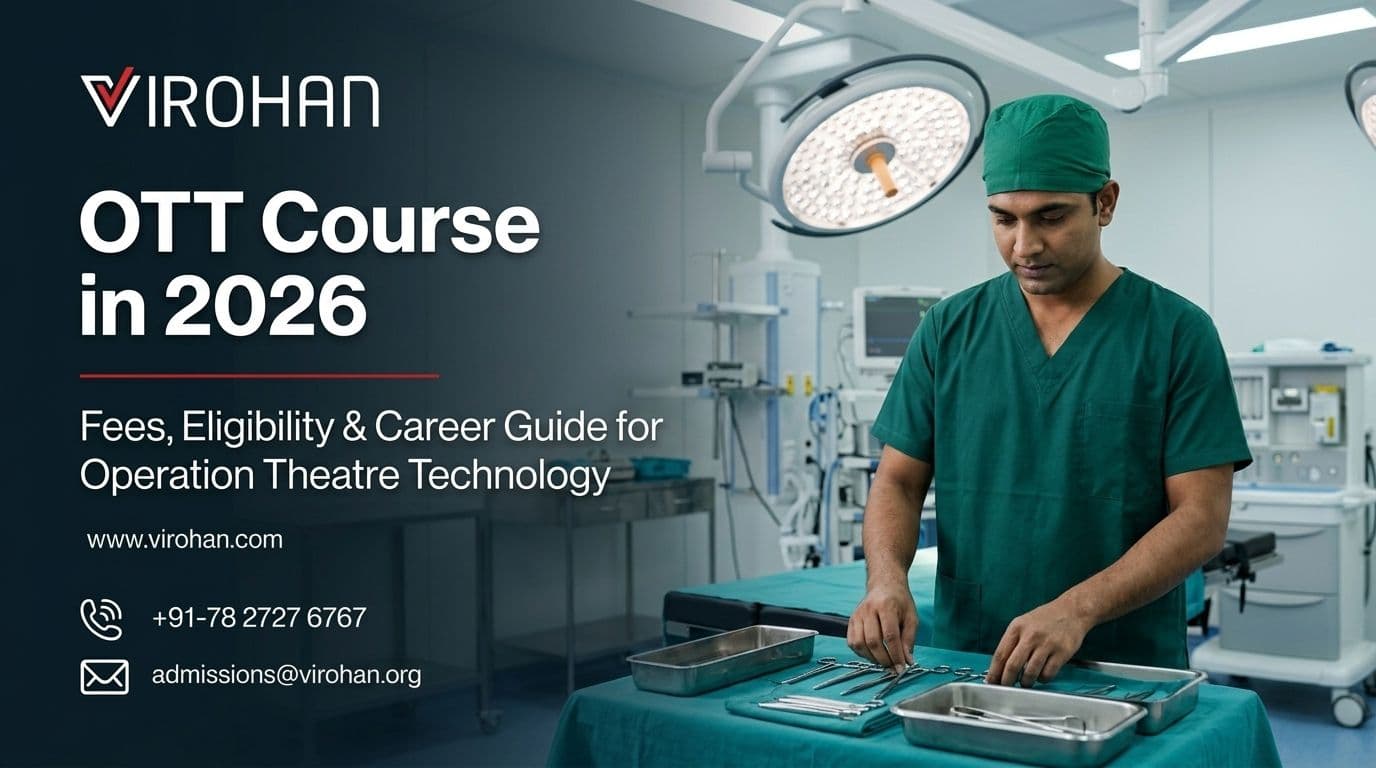
An OT Technician assists surgical teams inside the operation theatre. The degree route into the role is the Bachelor of Anaesthesia & Operation Theatre Technology (B.AOTT), a 4-year program that includes a 1-year internship. You need 12th pass with 40% in all subjects individually, with PCB or PCM, and NEET is not required. Operation Theatre Technicians in India earn an average of ₹3.1 LPA (AmbitionBox, September 2026), and you can study B.AOTT at universities partnering with Virohan such as Vikrant University, Gwalior and SR University, Warangal.
OT Technicians prepare operation theatres, sterilize instruments, set up anaesthesia and monitoring equipment, and keep the sterile field safe during procedures. Below, you will find how to become an OT Technician, eligibility, fees, subjects, salary, career growth and where to study B.AOTT in 2026.
OT Technician Course Information
| Field | Details |
|---|
| Course Name | Bachelor of Anaesthesia & Operation Theatre Technology (B.AOTT), formerly BSc Anaesthesia and OT Technology; searched as the OT Technician course |
| Course Level | Undergraduate degree |
| Course Duration | 4 years, including a 1-year internship |
| Admission Process | Merit-based on 12th marks; some universities run their own entrance test. NEET is not required |
| Course Eligibility | 12th pass with 40% in all subjects individually; PCB/PCM mandatory; minimum age 17 |
| Course Fees | ₹8,60,000 total for 4 years at every university partnering with Virohan, plus ₹10,000 registration; government institutions set their own fees |
| Job Profiles | Operation Theatre Technician, Anaesthesia Technician, Cardiac OT Technician, Laparoscopic OT Technician, OT Coordinator |
| Average Annual Salary | Operation Theatre Technician ₹3.1 LPA average; OT Incharge ₹6 LPA average (AmbitionBox, September 2026) |
What Is an OT Technician Course?
An OT Technician course trains you to support surgeons, anaesthetists and nurses during procedures: preparing operation theatres, handling surgical instruments, maintaining sterile conditions and monitoring patient vitals throughout surgery. The role demands precision and calm judgment under pressure.
Operation theatre and anaesthesia technology is one of the allied and healthcare professions regulated by the National Commission for Allied and Healthcare Professions (NCAHP), the statutory body under the Ministry of Health and Family Welfare. NCAHP has notified the Anaesthesia and Operation Theatre Technology curriculum, listed on the NCAHP curriculum page, and the degree name is B.AOTT.
How to Become an OT Technician in India
- Choose PCB or PCM in 11th and 12th. B.AOTT accepts either stream.
- Pass 12th with 40% in all subjects individually and be at least 17 by the intake cut-off.
- Apply for B.AOTT at a university. Admission is on 12th marks, and some universities run their own entrance test. NEET is not required.
- Complete the 4-year degree, including the 1-year internship in hospital operation theatres.
- Start as an Operation Theatre Technician and build toward specialist roles such as Cardiac OT Technician or Neurosurgery OT Technician, or supervisory roles such as OT Coordinator.
How to Become an Anaesthesia Technician
The same B.AOTT degree prepares you for anaesthesia work. The program covers anaesthesia equipment, drugs, patient monitoring and airway management alongside operation theatre technology. After graduation, you can work as an Anaesthesia Technician, preparing anaesthesia machines, assisting during induction and recovery, and monitoring patients under the anaesthetist's supervision. For salary and career detail on this path, read our guide to the anaesthesia technologist salary and career path.
Which Course Is Best for Working in an Operation Theatre?
B.AOTT is the NCAHP-named undergraduate degree for anaesthesia operation theatre technology. It combines three years of foundation and clinical subjects with a full year of internship in operation theatres, which builds the hands-on experience hospitals look for. It also opens progression into specialist theatre work, coordination roles, teaching after further study, and medical devices careers.
Hospitals and institutes also run diplomas in OT technology, usually over 2 years. If you are comparing a diploma with B.AOTT, look at the depth of the curriculum, the length and quality of the internship, and the roles each qualification leads to at the hospitals you want to work in.
What Is the Eligibility for an OT Technician Course?
For B.AOTT at universities partnering with Virohan, you need:
- Qualification and marks: 12th pass with 40% in all subjects individually; PCB/PCM mandatory
- Age: minimum 17 by the intake cut-off
- Entrance: NEET is not required; some universities run their own entrance test
UPES asks for 50% in individual subjects. Government institutions set their own admission rules and counselling processes. The NCAHP letter dated 08 April 2026 sets degree names and admission eligibility for AY 2026-27. Many allied and healthcare courses after 12th, including B.AOTT, admit students on 12th marks.
Can PCM Students Take Admission in an Anaesthesia and OT Technology Course?
Yes. B.AOTT accepts students with PCB or PCM in 12th. The program teaches anatomy, physiology, microbiology and pharmacology from the first year, so you build the biology foundation during the degree. PCM students can also explore other options in our guide to healthcare courses after 12th for PCM students.
What Is the Fee Structure for an OT Technician Course?
The total program fee for the 4-year B.AOTT is ₹8,60,000, plus a ₹10,000 registration fee, at every university partnering with Virohan that offers it. It covers tuition, theatre and laboratory access, examinations and the internship year; hostel and transport are billed separately. Government institutions are state-funded, with few seats allocated through state merit lists and counselling.
Check the current total program fee at Virohan's partner universities on virohan.com/courses or talk to our expert counsellors. When you compare costs, add accommodation, food, books and travel for all four years. Education loans are widely available, and merit-based scholarships may be available; amounts, eligibility and availability can change, so check the current terms before you apply.
What Does the OT Technician Curriculum Cover?
The curriculum combines medical-science fundamentals (human anatomy, physiology, biochemistry, microbiology, pathology and pharmacology) with operation theatre and anaesthesia skills: surgical procedures across specialties, anaesthesia technology, operation theatre management, infection control and sterilization, surgical instrument handling, patient positioning, emergency response, and medical law and ethics.
Practical training is central. B.AOTT programs include hands-on sessions in skills labs and hospital operation theatres, and the final-year internship rotates you through departments such as general surgery, orthopaedics, gynaecology and cardiac surgery.
How Long Is the OT Technician Course?
B.AOTT runs for 4 years, including a 1-year internship. The first three years build your foundation in medical sciences, operation theatre technology and anaesthesia technology, and the final year places you in hospital operation theatres under supervision.
Operation Theatre Technician Salary in India
| Role | Average salary | Top 10% earn above | Top 1% earn above | Source |
|---|
| Operation Theatre Technician | ₹3.1 LPA | ₹4.5 LPA | ₹13.7 LPA | AmbitionBox, September 2026 |
| Anaesthesia Technician | ₹3 LPA | ₹5 LPA | ₹6 LPA | AmbitionBox, September 2026 |
| OT Incharge | ₹6 LPA | ₹8 LPA | ₹16.5 LPA | AmbitionBox, September 2026 |
An average of ₹3.1 LPA works out to about ₹25,800 a month. Pay rises with experience, specialist theatre work and supervisory responsibility, and OT Incharge roles sit well above entry level. Government hospital posts follow pay commission scales with long-term benefits. These figures are indicative rather than guaranteed.
What Career Opportunities and Growth Are Available?
B.AOTT graduates work in multi-specialty hospitals, surgical and day-care centers, trauma and emergency units, and cardiac and transplant programs. Roles include:
- Operation Theatre Technician: prepares theatres, instruments and equipment, and supports the surgical team
- Anaesthesia Technician: prepares anaesthesia machines and monitors patients during induction and recovery
- Cardiac OT Technician: supports cardiac surgery teams
- Laparoscopic OT Technician: manages equipment for minimally invasive surgery
- Neurosurgery OT Technician: supports complex neurosurgical procedures
- OT Coordinator: schedules cases and coordinates theatre teams
- Medical Devices Sales Executive: works with surgical and anaesthesia equipment companies
With experience, you can move into OT supervision and management, or into teaching after further study. B.AOTT also features in our list of the highest paying allied and healthcare courses and the best healthcare degrees for high salary careers.
If you plan to work abroad later, each country licenses operation theatre and anaesthesia professionals through its own regulator, so check the destination's registration and language requirements early. If you are more interested in diagnostic work, you can compare lab technician courses.
What Is the Scope of Operation Theatre Technology in India?
Every operation theatre needs trained technical staff on every shift, and surgical services keep expanding across multi-specialty hospitals, day-care surgery centers and trauma units. Specialist areas such as cardiac surgery, neurosurgery and laparoscopic surgery need technicians with focused skills, which creates clear progression for experienced professionals.
NCAHP regulation of operation theatre and anaesthesia technology gives the profession a defined degree name, curriculum and competencies, and supports a documented career track from technician to specialist and coordinator roles.
Key Concepts and Terminology in OT Technology
Asepsis is the foundation of operation theatre work: creating an environment free from infectious agents to prevent post-operative infections. You learn the difference between medical asepsis (clean technique) and surgical asepsis (sterile technique), and when to apply each.
The autoclave is your primary sterilization tool, a pressurized steam device that decontaminates surgical instruments and supplies. Understanding autoclave cycles, temperature requirements and biological indicators ensures instruments are truly sterile, not just clean.
Common surgical terms you will master include laparotomy (surgical incision into the abdominal cavity), laparoscopy (minimally invasive surgery using small incisions and a camera), cauterization (using heat to stop bleeding), retraction (holding tissue aside so surgeons can see the operative field), and anastomosis (joining two structures surgically).
Anaesthesia responsibilities overlap with OT Technician work: monitoring patient vital signs, preparing anaesthesia equipment, and assisting during induction and recovery. Understanding pre-operative, intra-operative and post-operative protocols helps you anticipate needs and respond quickly during surgeries.
A Day in the Life of an OT Technician
Emergency appendectomy at 2 AM. As the OT Technician on duty, you power on the surgical lights, set up the suction apparatus, arrange instrument trays in order of use, and verify the autoclave indicators on each pack. You prepare monitoring equipment to track the patient's heart rate, blood pressure and oxygen saturation throughout the procedure.
Orthopaedic surgery to repair a fractured femur. You pass instruments to the surgeon at the right moment: drill, screws, plates. You maintain the sterile field, stay ready with gauze and suction, and alert the anaesthetist to any concerning change in vitals.
Post-surgery responsibilities. After the patient moves to recovery, you clean and decontaminate the operation theatre, dispose of bio-waste according to protocol, collect used instruments for sterilization, restock supplies, and prepare the room for the next case.
Where to Study B.AOTT: Universities with Virohan as Industry Partner
B.AOTT is available at these universities with Virohan as their industry partner:
| University | Location |
|---|
| Vikrant University | Gwalior, Madhya Pradesh |
| SR University | Warangal, Telangana |
| Lingaya's Vidyapeeth | Faridabad, Haryana |
| MIT University | Shillong, Meghalaya |
| Silver Oak University | Ahmedabad, Gujarat |
| HRIT University | Ghaziabad, Uttar Pradesh |
| BBD University | Lucknow, Uttar Pradesh |
| CMR University | Bengaluru, Karnataka |
| UPES | Dehradun, Uttarakhand |
| Invertis University | Bareilly, Uttar Pradesh |
| Shobhit University | Saharanpur, Uttar Pradesh |
| |
The universities teach and award the degree, and Virohan works with them as industry partner. Virohan has nearly a decade in allied and healthcare education, and students get access to 2,000+ healthcare employer partners across 20+ cities for internship and job opportunities, along with communication, leadership, digital literacy and English language skills.
How Do You Plan Your B.AOTT Application?
- Confirm your eligibility: 12th pass with PCB or PCM, the required marks, and minimum age 17.
- Shortlist universities based on curriculum, hospital tie-ups, internship settings and total program fees.
- Track application deadlines and any university entrance test.
- Talk to our expert counsellors for guidance on choosing the right university.
Conclusion
An OT Technician career puts you at the center of surgical care, and B.AOTT is the degree that prepares you for it: 4 years including a 1-year internship, open to PCB and PCM students, with no NEET requirement. It leads to operation theatre, anaesthesia and specialist theatre roles, with clear progression into coordination and supervision. Compare universities on curriculum, internship settings and total fees, and talk to our expert counsellors when you are ready to choose.