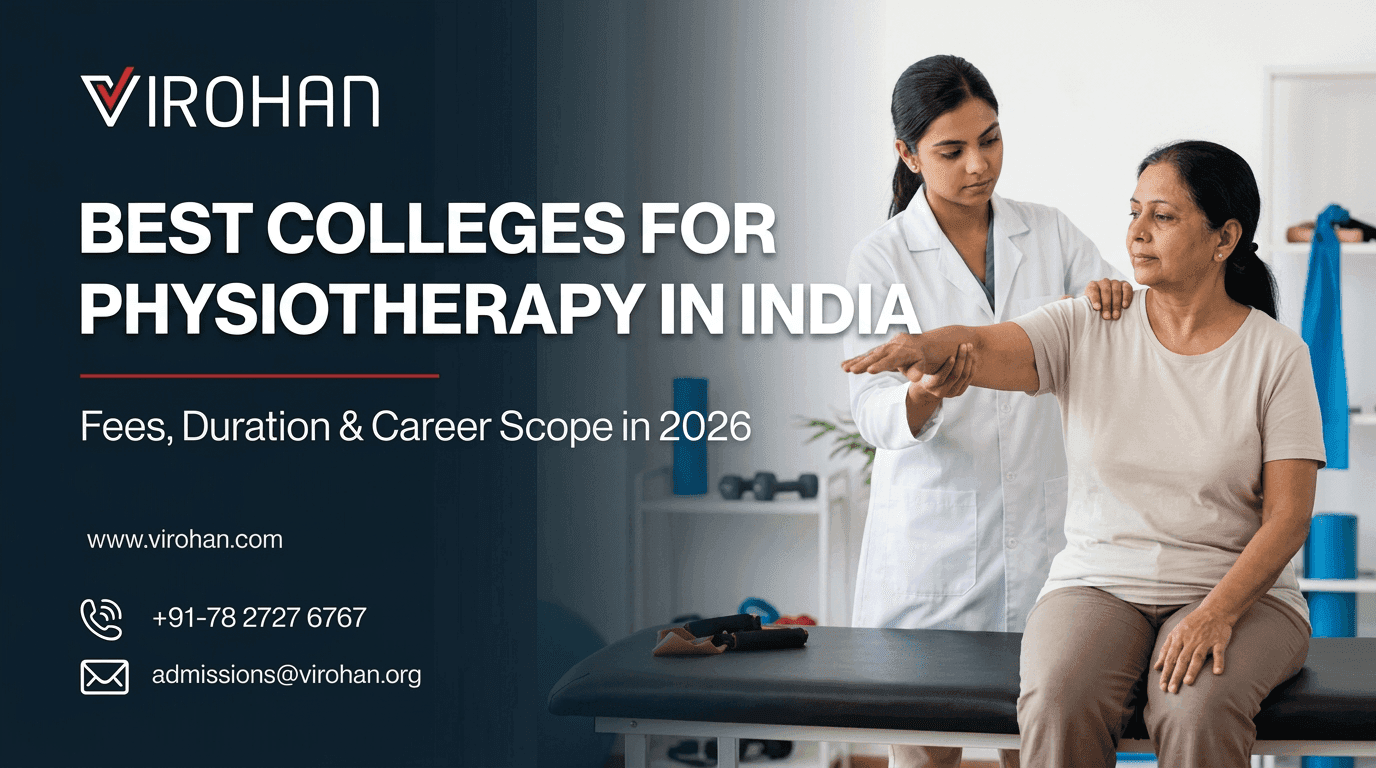
India's healthcare sector is undergoing a quiet revolution, and physiotherapy is at the centre of it. Hospitals are expanding rehabilitation wings, sports franchises are hiring full-time physios, and corporate wellness programs are bringing movement specialists into the office. The demand for qualified physiotherapists has never been higher, and a Bachelor of Physiotherapy (BPT) is the degree that opens this door.
This guide covers everything you need to know about pursuing a physiotherapy course in India: what the profession involves, how the BPT program works, the specialisations available, the careers you can build, and the top 9 colleges where you can study BPT in 2026. If you're exploring other allied and healthcare career paths, physiotherapy stands out as one of the highest-paying options in the sector.
What is Physiotherapy?
Physiotherapy is a branch of healthcare focused on restoring, maintaining, and maximising physical function and movement. Unlike approaches that rely primarily on medication or surgery, physiotherapy uses evidence-based physical interventions, including exercise prescription, manual therapy, and electrotherapy, to help patients recover from injury, manage chronic conditions, and prevent disability.
The scope of physiotherapy spans five major domains:
Musculoskeletal Rehabilitation deals with conditions affecting bones, joints, muscles, and connective tissue. This includes recovery after fractures, ligament tears, joint replacements, and the management of chronic conditions like arthritis and lower back pain. Musculoskeletal physiotherapy is the most common area of practice and accounts for the largest share of outpatient physiotherapy cases in India.
Sports Physiotherapy focuses on the prevention, assessment, and treatment of injuries related to sport and physical activity. With the Indian Premier League, Indian Super League, and Pro Kabaddi League growing each year, the demand for sports physiotherapists who understand athletic biomechanics and performance optimisation continues to rise.
Neurological Rehabilitation addresses conditions affecting the brain, spinal cord, and nervous system. Patients recovering from stroke, traumatic brain injury, spinal cord injury, and those managing progressive conditions like Parkinson's disease or multiple sclerosis depend on neurological physiotherapy to regain independence in daily life.
Cardiopulmonary Rehabilitation supports patients with heart and lung conditions. After cardiac surgery, during recovery from respiratory illness, or for the long-term management of conditions like COPD and asthma, cardiopulmonary physiotherapy improves breathing capacity, exercise tolerance, and overall quality of life.
Paediatric and Community Rehabilitation works with children experiencing developmental delays, cerebral palsy, or congenital conditions, as well as broader community health initiatives promoting physical activity, fall prevention in the elderly, and workplace ergonomics.
A qualified physiotherapist is not a technician who follows instructions from a doctor. They are autonomous healthcare practitioners who assess patients independently, diagnose movement disorders, and design treatment plans. This clinical independence is what makes physiotherapy a respected and rewarding profession.
BPT Course: The Complete Picture
The Bachelor of Physiotherapy (BPT) is the foundational degree required to practise as a physiotherapist in India. It is a professional undergraduate program regulated by the National Commission for Allied and Healthcare Professionals (NCAHP), which sets the curriculum standards, eligibility criteria, and ethical guidelines for allied and healthcare professionals across the country.
Duration
The BPT course spans 4 years of academic and clinical study followed by a compulsory 1-year clinical internship, making the total program duration 5 years. The internship is completed in a hospital or clinical setting where students work with patients under supervision, applying the theoretical knowledge gained during the academic years to real clinical scenarios.
Eligibility
To be eligible for admission to a BPT program, you must meet the following criteria:
- Educational qualification: Passed Class 12 (10+2) with Physics, Chemistry, and Biology (PCB) as core subjects from a recognised board.
- Minimum marks: Minimum marks requirements vary by university. Some institutions may offer relaxation for reserved category candidates. Check with your chosen institution for specific requirements.
- Entrance exam: Admission requirements can vary by university. Check with your chosen university for their specific admission process.
- Age: Candidates must have completed 17 years of age at the time of admission or by December 31 of the admission year.
Admission processes for BPT vary across institutions. It is important to check the specific requirements of each university you are considering, as these may include entrance exams, merit-based selection, or a combination of both.
Curriculum
The BPT curriculum builds clinical competence progressively across four academic years, moving from foundational sciences to specialised physiotherapy practice.
First Year establishes the scientific foundation: Human Anatomy (structure of joints, muscles, nerves, and organ systems), Physiology (how the body's systems function), Biochemistry, and Biomechanics, the defining subject of physiotherapy that teaches how forces act on the body during movement and how to analyse gait, posture, and joint mechanics.
Second Year introduces core physiotherapy modalities. Exercise Therapy covers therapeutic exercise prescription, including strengthening, stretching, balance training, and functional movement. Electrotherapy teaches the use of ultrasound, TENS, interferential therapy, shortwave diathermy, and laser therapy for pain management and tissue healing. Pathology, Microbiology, and Pharmacology round out the year.
Third Year moves into clinical subjects: Orthopaedic Physiotherapy (post-fracture rehabilitation, joint mobilisation, post-surgical protocols), Neurological Physiotherapy (stroke rehabilitation, spinal cord injury management, treatment of conditions like Parkinson's disease), General Medicine, General Surgery, and Community-Based Rehabilitation.
Fourth Year covers Cardiopulmonary Physiotherapy (respiratory assessment, cardiac rehabilitation, COPD management), Sports Physiotherapy (injury prevention, taping techniques, return-to-play protocols), Research Methodology and Biostatistics, and Ethics and Professional Practice.
12-Month Clinical Internship is the final phase. You rotate through orthopaedics, neurology, cardiopulmonary, paediatrics, and general medicine departments, assessing patients, designing treatment plans, and delivering interventions under supervision. This is where classroom learning transforms into clinical confidence.
Specialisation Areas in Physiotherapy
After completing your BPT, the field offers multiple specialisation pathways. While deeper specialisation often develops through focused clinical experience in a particular domain, understanding these areas helps you orient your career from the start.
Orthopaedic Physiotherapy
The most widely practised specialisation, dealing with rehabilitation of musculoskeletal injuries and conditions: fractures, joint replacements (hip, knee, shoulder), ligament reconstructions, spinal disc problems, and chronic pain conditions like frozen shoulder or tennis elbow. Manual therapy techniques including joint mobilisation, soft tissue manipulation, and myofascial release form a core part of practice.
Neurological Physiotherapy
Focuses on conditions affecting the brain, spinal cord, and nervous system. Stroke rehabilitation is the most common area of practice, helping patients regain the ability to walk, use their arms, and perform daily activities. Spinal cord injury rehabilitation, management of Parkinson's disease and multiple sclerosis, and traumatic brain injury recovery all fall under this specialisation.
Sports Physiotherapy
Covers the prevention, diagnosis, and treatment of sports-related injuries, from acute management on the field to post-surgical rehabilitation and biomechanical analysis. With the growth of the IPL, ISL, Pro Kabaddi League, and other professional sports in India, this has become one of the most sought-after specialisations.
Paediatric Physiotherapy
Works with infants, children, and adolescents experiencing developmental delays, congenital conditions (cerebral palsy, Down syndrome, spina bifida), and childhood injuries. Treatment approaches are play-based and family-centred, helping children achieve motor milestones. Early intervention can make a significant difference in long-term functional abilities.
Cardiopulmonary Physiotherapy
Addresses heart and lung conditions. In ICU settings, cardiopulmonary physiotherapists help ventilated patients wean off ventilators and maintain muscle strength. In outpatient settings, they run cardiac and pulmonary rehabilitation programs for patients with COPD, asthma, or post-surgical recovery needs.
Women's Health Physiotherapy
An emerging area addressing conditions specific to women: prenatal and postnatal exercise, pelvic floor rehabilitation, recovery after gynaecological surgery, and osteoporosis management. As awareness of pelvic health grows in India, this specialisation is gaining significant traction in urban centres.
Career Paths After BPT
A BPT degree opens the door to diverse career paths across healthcare and wellness. This is not a single-track profession.
Hospital-Based Practice is the most traditional path, placing you in physiotherapy departments, ICUs, orthopaedic wards, and neurology units of government and private hospitals. Large chains like Apollo, Fortis, Max Healthcare, and Narayana Health regularly recruit BPT graduates. Hospital practice builds broad clinical skills and exposes you to a wide variety of conditions.
Sports Teams and Academies employ physiotherapists for injury prevention, acute management, and rehabilitation. Professional cricket teams, ISL clubs, Pro Kabaddi League teams, and sports academies all need qualified physios. This path is competitive but offers exciting work environments and travel opportunities.
Rehabilitation Centres focus on helping patients recover from specific conditions over extended periods. Neuro-rehabilitation centres work with stroke and spinal cord injury patients, orthopaedic centres handle post-surgical recovery, and geriatric care centres maintain mobility and independence in elderly patients. This setting allows you to build deep expertise in a specific population.
Private Practice offers clinical independence and the potential for significantly higher earnings. Many physiotherapists start in hospital settings to build experience and reputation, then establish their own clinics. A well-run private clinic in a metropolitan area can be highly rewarding both professionally and financially.
Corporate Wellness is a growing field. Companies are hiring physiotherapists to conduct ergonomic assessments, run injury prevention workshops, and provide on-site treatment for employees dealing with neck pain, back pain, and repetitive strain injuries. IT companies, manufacturing firms, and large corporate offices are the primary employers.
Community and Public Health roles are expanding through the Ayushman Bharat scheme and district hospital expansion, creating new positions for physiotherapists in tier-2 and tier-3 cities. NGOs and government programs also employ physiotherapists for disability prevention and rural healthcare delivery.
Teaching and Research is an option for those with a passion for academics. Advanced qualifications and clinical experience open the door to faculty positions in physiotherapy colleges and research roles in rehabilitation science and biomechanics.
Physiotherapy Salary in India
Physiotherapy offers strong earning potential that grows with experience, specialisation, and the setting you choose to work in.
According to PayScale and Glassdoor data, fresh BPT graduates working in hospital settings can expect starting salaries in the range of INR 25,000 to INR 40,000 per month, with metropolitan cities and large private hospital chains typically offering the higher end of this range. Government hospital positions come with the added benefits of job security, pension, and structured pay scales under the 7th Pay Commission.
With two to five years of experience and the development of a specialised skill set, physiotherapists regularly earn INR 50,000 to INR 70,000 per month. Those who specialise in high-demand areas like sports physiotherapy or neuro-rehabilitation, or who work in premium healthcare facilities, often command higher compensation.
The potential to earn up to a lakh per month or more exists for experienced physiotherapists, particularly those in private practice, senior hospital positions, or specialised roles with professional sports teams. Private practice earnings are especially variable: a well-established physiotherapy clinic in a metropolitan area can generate substantial income, with some practitioners earning well beyond salaried benchmarks.
Location plays a role as well. Metropolitan cities like Mumbai, Delhi, Bengaluru, and Chennai offer higher salaries, while tier-2 cities like Lucknow, Pune, Ahmedabad, and Chandigarh are closing the gap as healthcare infrastructure expands. International opportunities in the Middle East, Australia, the UK, and Canada offer substantially higher compensation for physiotherapists with Indian qualifications and additional certifications.
Physiotherapy Course Fees
BPT course fees vary considerably depending on the type of institution.
Government universities offer the most affordable pathway, with annual fees typically ranging from INR 20,000 to INR 60,000. These institutions are funded by state or central governments, keeping tuition costs low while maintaining quality clinical training through attached teaching hospitals.
Private universities charge higher fees, generally ranging from INR 80,000 to INR 2,50,000 per year. The variation depends on the university's infrastructure, location, hospital facilities, and brand reputation. Some premium private institutions may charge more, but the investment often comes with modern labs, better student-to-faculty ratios, and stronger placement support.
When calculating total cost, factor in the complete 5-year duration plus living expenses, books, and clinical equipment. Most institutions accept education loans, and scholarship schemes are available through state governments, central government initiatives, and institutional merit-based awards. Research these options early in your application process.
Where to Study: Top 9 Physiotherapy Colleges in India
Choosing where to pursue your BPT involves evaluating several factors: the quality of clinical exposure, faculty expertise, hospital infrastructure, placement support, and the overall learning environment. India has both established government institutions and private universities that offer strong BPT programs. Admission processes vary by institution.
Here are nine physiotherapy colleges and university programs worth considering in 2026:
1. AIIMS Delhi
The All India Institute of Medical Sciences in New Delhi is one of the most prestigious medical institutions in the country. Its physiotherapy program benefits from access to a massive teaching hospital with unmatched patient volume and case diversity. Admission is extremely competitive, based on the institution's own selection process. Fees are minimal, making it one of the most affordable options.
2. Christian Medical College (CMC), Vellore
CMC Vellore has a long-standing reputation for clinical excellence and a patient-centred approach to healthcare education. The BPT program offers rotations across a 2,700-bed teaching hospital, exposing students to a wide range of conditions in orthopaedics, neurology, cardiopulmonary care, and paediatrics. Admission is through CMC's own counselling and selection process.
3. Kasturba Medical College (KMC), Manipal
Part of Manipal Academy of Higher Education, KMC Manipal offers a well-structured BPT program with strong clinical training infrastructure. The campus has modern rehabilitation labs and access to Kasturba Hospital for clinical rotations. Manipal's national reputation and alumni network add value beyond the degree itself. Admission is through the university's own selection process.
4. Seth GS Medical College and KEM Hospital, Mumbai
Attached to the KEM Hospital, one of Mumbai's largest public teaching hospitals, this institution offers outstanding clinical exposure. BPT students work alongside experienced clinicians across high-volume orthopaedic, neurological, and general medicine departments. Being a government institution, fees are low and admission is based on the Maharashtra state counselling process.
5. Pt. Deendayal Upadhyaya National Institute for Persons with Physical Disabilities (PDUNIPPD), Delhi
Formerly known as the Institute for the Physically Handicapped, PDUNIPPD is a central government institution under the Ministry of Social Justice and Empowerment. Its BPT program is specifically oriented towards disability rehabilitation, giving students deep exposure to neurological and orthopaedic rehabilitation. Admission is through the institution's selection process, and fees are heavily subsidised.
6. Silver Oak University, Ahmedabad (with Virohan as Education-to-Industry Partner)
Silver Oak University is a NAAC A+ accredited institution offering a UGC-approved BPT program. What sets it apart is its partnership with Virohan as the education-to-industry partner. This means students receive the university's academic degree alongside the opportunity to connect with Virohan's network of 2000+ healthcare industry partners across hospitals and diagnostic centers, and dedicated placement support that connects candidates with employers across the healthcare sector. Admission is through the university's own selection process.
7. G H Raisoni International Skill Tech University, Pune (with Virohan as Education-to-Industry Partner)
G H Raisoni International Skill Tech University in Pune offers a UGC-approved BPT program with Virohan as the education-to-industry partner. Students benefit from a hands-on clinical training approach, industry mentorship, and career services designed to bridge the gap between graduation and employment. Pune's growing healthcare ecosystem provides a strong backdrop for clinical rotations and post-graduation career opportunities. Admission is through the university's own selection process.
8. SRM Institute of Science and Technology, Chennai
SRM is one of the largest private universities in India, and its College of Physiotherapy offers a comprehensive BPT program with access to SRM Hospital and Research Centre. The program includes modern rehabilitation labs, well-structured clinical postings, and an active placement cell. Admission is through SRM's own counselling and selection process.
9. Lovely Professional University (LPU), Jalandhar
LPU offers a BPT program with good infrastructure and access to its on-campus hospital for clinical training. The university has a strong emphasis on placement support and industry connections, with regular campus recruitment drives. It is particularly suitable for students from North India looking for a private university option with competitive fees. Admission is through the university's own selection process.
Why Consider BPT Programs at Partner Universities with Virohan?
For students looking for a BPT degree that is closely integrated with industry exposure and practical skill development, universities that have partnered with Virohan as their education-to-industry partner offer a distinct advantage. The universities design and award the BPT degree (which is UGC-approved and fully recognised), while Virohan brings in the industry connection: Virohan's network of 2000+ top healthcare brands gives learners the opportunity to get hands-on clinical experience through structured internships. Virohan also ensures they get career guidance, and placement support that connects them with employers across the healthcare sector.
BPT programs at universities with Virohan as the education-to-industry partner are available across 9 cities in 7 states, meaning students can often find a program close to home. Each program provides structured support beyond the classroom: clinical placement coordination through healthcare industry partners across hospitals and diagnostic centers, industry mentorship, and career services designed to ensure that graduates are not just academically qualified but clinically competent and job-ready.
How to Choose the Right Physiotherapy College
With multiple options available, making the right choice requires evaluating factors that will shape your education and career.
Clinical exposure is non-negotiable. The quality of your clinical training depends on the hospital environment you are placed in. Look for programs that offer rotations in multi-specialty hospitals with high patient volumes. Ask about the student-to-patient ratio during clinical postings and whether you will get hands-on practice or merely observe.
Faculty qualifications matter. Experienced faculty with clinical backgrounds teach differently from those with only academic experience. Look for programs where faculty members have worked in hospitals, sports settings, or rehabilitation centres. Their real-world insights enrich classroom learning.
Placement support reflects institutional commitment. Colleges and universities that invest in placement cells, industry partnerships, and career guidance demonstrate a commitment to student outcomes beyond exam results. Ask about placement rates, the types of organisations that recruit from the institution, and the average starting salaries of recent graduates.
Location shapes your opportunities. Cities with large healthcare ecosystems, such as Bengaluru, Delhi NCR, Mumbai, Pune, and Ahmedabad, offer more clinical training sites and better post-graduation employment prospects. However, institutions in emerging healthcare cities also have advantages, including lower competition for clinical placements and growing local demand for physiotherapists.
Total cost, not just tuition. Calculate the full financial picture: tuition fees for 5 years, hostel or accommodation costs, food, travel, books, and clinical equipment. Compare this with the earning potential in your chosen career path to make an informed decision.
Accreditation and recognition. Ensure the university is UGC-approved and the BPT program is recognised by the relevant state or national regulatory body. A degree without proper recognition limits your ability to practise, pursue further education, or seek employment in government institutions.
Physiotherapy Course After 12th: Getting Started
If you are in Class 12 or have recently completed it with PCB subjects, here is a step-by-step approach to beginning your physiotherapy journey.
Step 1: Confirm your eligibility. You need 12th with Physics, Chemistry, and Biology from a recognised board. Minimum marks requirements vary by university — check with your chosen institution. You must also be at least 17 years old at the time of admission.
Step 2: Prepare for entrance exams. Check the admission requirements of your target institutions. Some universities conduct their own entrance exams, while others use merit-based selection from Class 12 board results. Start your preparation early and aim for the strongest possible academic performance.
Step 3: Research institutions. Based on your academic performance and entrance exam results, evaluate the institutions where your profile is competitive. Look at government medical universities in your state, private universities with strong clinical infrastructure, and universities with industry partnerships that offer placement support.
Step 4: Apply strategically. Apply to a mix of institutions: some where your profile comfortably qualifies you, and some aspirational options. Keep track of application deadlines, counselling dates, and document requirements. Missing a deadline can cost you a year.
Step 5: Evaluate offers carefully. If you receive multiple offers, compare them on clinical exposure, total cost, placement record, and location. Visit campuses if possible and talk to current students or recent graduates. BPT is a 5-year commitment that is academically demanding, clinically intensive, and deeply rewarding.
Conclusion
Physiotherapy is one of the most rewarding healthcare careers you can pursue. It combines scientific knowledge with hands-on patient care, offers diverse specialisation pathways, and provides the satisfaction of directly helping people recover and thrive. The demand for skilled physiotherapists in India is growing across hospitals, sports organisations, rehabilitation centres, and corporate wellness programs.
The BPT course is your entry point. A rigorous 5-year program, it builds clinical competence from the ground up, covering everything from human anatomy and biomechanics to specialised rehabilitation techniques. With a curriculum designed to produce competent healthcare professionals, the BPT equips you with the knowledge and skills the profession demands.
Where you study matters, but it is not just about brand names. The quality of clinical exposure, the support you receive in transitioning from student to practitioner, and the connections you build with the healthcare industry all shape your career trajectory. Whether you choose a government institution like AIIMS or CMC Vellore, or a BPT program at a university with Virohan as the education-to-industry partner where industry-integrated training and placement support come built in, focus on programs that prioritise practical competence alongside academic excellence.
Start your journey with clarity about what physiotherapy involves, prepare diligently for entrance exams, choose your institution wisely, and commit fully to the training ahead. If you need guidance on finding the right university program, talk to our expert counsellors to get started. The career waiting on the other side is both professionally fulfilling and genuinely meaningful.
Disclaimer: This guide includes information about programs offered at partner universities with Virohan as the education-to-industry partner. Virohan is not a university or degree-awarding institution. All degrees and certifications are awarded by the respective partner universities. Salary figures, fee estimates, and placement outcomes mentioned in this article are approximate and may vary based on location, institution, employer, and individual performance. Readers are advised to verify program details directly with the institutions.