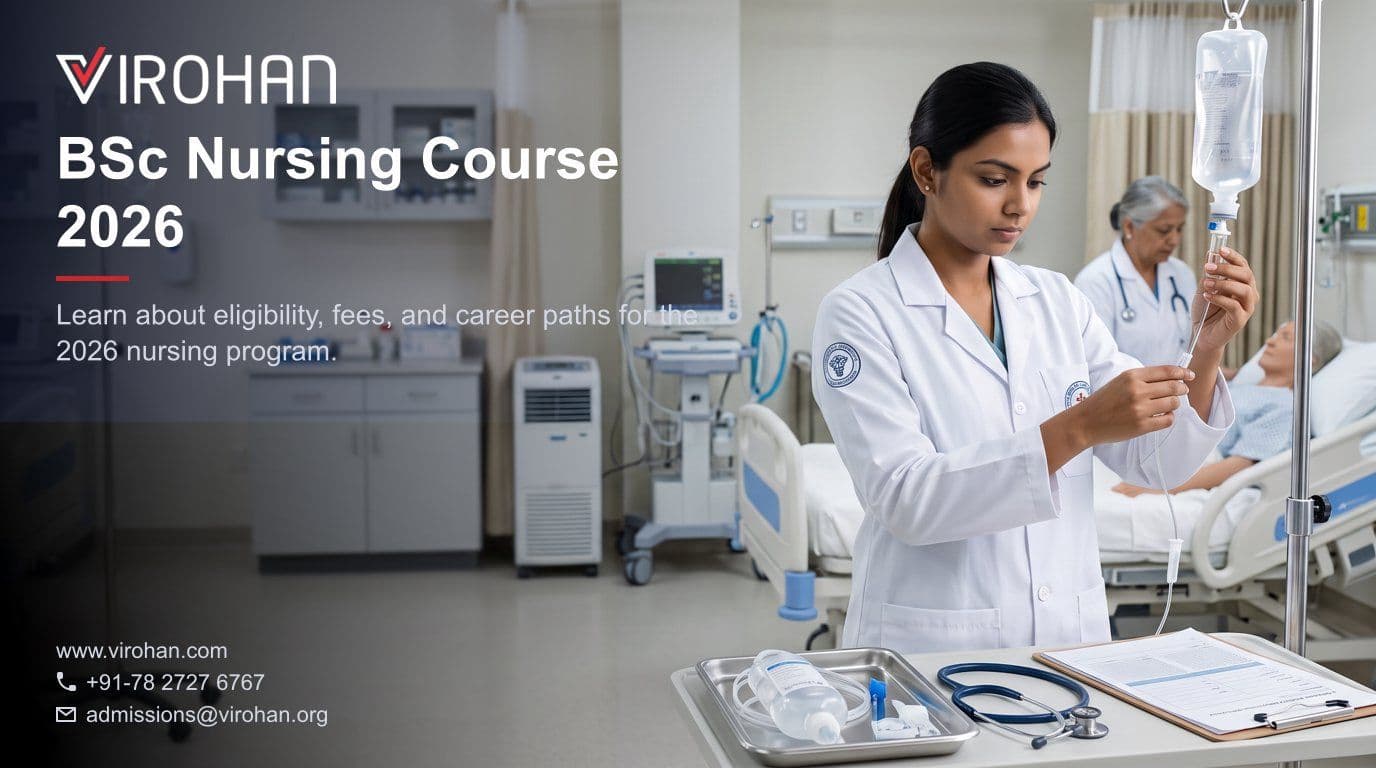
BSc Nursing is a four-year undergraduate degree regulated by the Indian Nursing Council (INC). It prepares you for registered nurse and registered midwife roles through classroom study, skill-lab practice and supervised clinical postings in hospitals and community settings.
Below you will find the 2026 eligibility rules, the semester-wise syllabus, admission routes, fee ranges, salary data and career paths, so you can judge whether nursing fits your subjects and goals.
| Course Information | Details |
|---|
| Course Name | Bachelor of Science in Nursing (B.Sc. Nursing) |
| Course Level | Undergraduate |
| Course Duration | 4 years (8 semesters, with a 22-week internship in the 8th semester) |
| Admission Process | Entrance test conducted by the university or state government; some institutions use NEET-UG scores |
| Course Eligibility | 10+2 with Physics, Chemistry and Biology (45% taken together; 40% for SC/ST/OBC) and a pass in English; age 17 to 35 |
| Course Fees | Indicative ₹40,000 to ₹12 lakhs total over 4 years, depending on institution type |
| Job Profiles | Staff Nurse, ICU Nurse, Community Health Nurse, Nurse Educator, Nursing Superintendent |
| Average Annual Salary | ₹3.08 LPA for Staff Nurses (PayScale India, 2026); ₹10.4 LPA for experienced Nursing Superintendents (AmbitionBox, 2026) |
What Is BSc Nursing?
BSc Nursing is a professional degree that trains you to assess patients, deliver safe bedside care, give medicines under clinical protocols and educate patients and families. The Indian Nursing Council sets the curriculum, admission terms and clinical training requirements that every recognized nursing college follows.
The current framework is INC's Revised Regulations and Curriculum for B.Sc. (Nursing) Program, notified in July 2021 and updated by a corrigendum in 2022. It uses a competency-based, credit and semester system built around ten core competencies, with foundational, core and elective courses.
When you complete the program, you register with your State Nursing Registration Council as a Registered Nurse and Registered Midwife (RN & RM). That registration is what allows you to work as a nurse. Because a large share of the program happens on wards and in community postings, the degree suits you if you enjoy science, structured routines and long-term patient contact.
BSc Nursing Duration and Syllabus
BSc Nursing runs for four years across eight semesters. The first seven semesters combine theory, skill-lab practice and clinical postings. The eighth semester is a full internship: 22 weeks at 48 hours a week, or 1,056 hours of intensive practicum and residency posting.
The semester-wise structure under the INC curriculum is:
| Semester | Core courses |
|---|
| I | Communicative English, Applied Anatomy, Applied Physiology, Applied Sociology, Applied Psychology, Nursing Foundation I |
| II | Applied Biochemistry, Applied Nutrition and Dietetics, Nursing Foundation II, Health/Nursing Informatics and Technology |
| III | Applied Microbiology and Infection Control including Safety, Pharmacology I, Pathology I, Adult Health (Medical Surgical) Nursing I |
| IV | Pharmacology II, Pathology II and Genetics, Adult Health Nursing II including Geriatric Nursing, Professionalism, Professional Values and Ethics including Bioethics |
| V | Child Health Nursing I, Mental Health Nursing I, Community Health Nursing I (including Environmental Science and Epidemiology), Educational Technology/Nursing Education, Introduction to Forensic Nursing and Indian Laws |
| VI | Child Health Nursing II, Mental Health Nursing II, Nursing Management and Leadership, Midwifery/Obstetrics and Gynaecology Nursing I |
| VII | Community Health Nursing II, Nursing Research and Statistics, Midwifery/Obstetrics and Gynaecology Nursing II |
| VIII | Internship (intensive practicum and residency posting) |
Mandatory modules sit inside these courses. You learn First Aid within Nursing Foundation I, Basic Cardiac Life Support within Adult Health Nursing I, and newborn care modules within Child Health Nursing. Elective modules add a small number of credits across the program.
Clinical postings take you through medical and surgical wards, critical care, paediatric and maternity units, mental health settings and community health programs. When you shortlist colleges, ask which hospitals host their postings and how clinical hours are logged and assessed.
BSc Nursing Eligibility and Admission 2026
Eligibility criteria
INC's admission terms set the minimum bar that every nursing college applies:
- Qualification: 10+2 with Physics, Chemistry and Biology, with at least 45% in the three subjects taken together, and a pass in English. English is a compulsory subject at 10+2.
- Reserved categories: SC/ST/OBC candidates need 40% in Physics, Chemistry and Biology, plus a pass in English.
- Open schooling: candidates from State Open Schools recognized by a state government, or from NIOS, are eligible if they studied science subjects and English.
- Age: at least 17 years on 31 December of the admission year, and no more than 35 years. The upper age limit is relaxed by five years for candidates with disabilities.
- Medical fitness: you must be medically fit. Married candidates are eligible, and color-blind candidates are eligible if they wear corrective lenses or spectacles.
Admissions happen once a year. States and individual colleges can set additional conditions, so read the admission notice for each institution you plan to apply to.
Entrance exams and admission process
Under INC's regulations, selection is based on merit in an entrance test conducted by the university or state government. The test covers Aptitude for Nursing, Physics, Chemistry, Biology and English, with 20 marks for each. Since the 2022 corrigendum, the qualifying bar is the 50th percentile for general candidates, the 45th percentile for general candidates with disabilities, and the 40th percentile for SC/ST/OBC candidates, including those with disabilities.
The exact route varies by institution. AIIMS runs its own entrance exam for B.Sc. (Hons) Nursing, several states hold nursing entrance tests, and some institutions use NEET-UG scores. Follow registration dates, admit cards and counselling rounds only on official portals, and keep your mark sheets, age proof, category certificate and medical fitness certificate ready.
BSc Nursing Fees
Total program fees for BSc Nursing vary widely by institution type. Use these indicative ranges for planning:
| Institution type | Indicative total program fee (4 years) |
|---|
| Government colleges | ₹40,000 to ₹2 lakhs |
| Private colleges | ₹2 lakhs to ₹10 lakhs |
| Deemed universities | ₹4 lakhs to ₹12 lakhs |
Tuition is only part of the cost. Budget for hostel and mess charges, uniforms, books, exam fees and travel to clinical postings. Ask each institution for a written breakup of the total program fee, the payment schedule and the refund rules before you accept a seat.
BSc Nursing Salary and Career Scope
BSc Nursing graduates work as Staff Nurses, ICU Nurses, Community Health Nurses and Nurse Educators, and experienced nurses move into leadership roles such as Nursing Superintendent. Employers include multi-specialty hospitals, government health services, home-care providers, schools and public health programs.
Salary data from public platforms shows how pay grows with experience and responsibility:
| Role | Indicative annual salary | Data |
|---|
| Staff Nurse (under 1 year of experience) | ₹2.30 LPA average | PayScale India, 2026 |
| Staff Nurse (all experience levels) | ₹3.08 LPA average; ₹1.74 LPA to ₹10 LPA range | PayScale India, 2026 |
| Nurse Educator | ₹5.2 LPA average; top 10% earn above ₹6.6 LPA | AmbitionBox, 2026 |
| Nursing Superintendent (experienced) | ₹10.4 LPA average | AmbitionBox, 2026 |
All figures are indicative. Pay depends on employer, city, specialty and experience, and no degree comes with a guaranteed job or a fixed package.
Higher study options include MSc Nursing and nurse practitioner programs, which lead to specialist, teaching and leadership roles. If you plan to work abroad, you will need to meet the destination country's registration, language and licensing requirements, such as the NCLEX-RN exam for the United States.
Allied and Healthcare Degrees at Universities Partnering with Virohan
If hands-on patient care is what draws you to nursing, allied and healthcare careers are worth exploring on their own merits. These professionals work in physiotherapy, eye care, diagnostic laboratories, medical imaging and operation theatres across hospitals and diagnostic chains.
Universities partnering with Virohan as their industry partner offer these undergraduate degrees. The minimum age for each is 17.
| Program | Eligibility | NEET requirement |
|---|
| Bachelor of Physiotherapy (BPT) | 12th pass with 40% in all subjects individually; English mandatory; minimum 50% in PCB | Not required for AY 2026-27; deferred to AY 2027-28 |
| Bachelor of Optometry (B.Optom) | 12th pass with 40% in all subjects individually; minimum 50% in PCB/PCM | Not required |
| Bachelor of Medical Laboratory Science (B.MLS) | 12th pass with 40% in all subjects individually; PCB mandatory | Not required |
| Bachelor of Medical Radiology and Imaging Technology (B.MRIT) | 12th pass with 40% in all subjects individually; PCB mandatory | Not required |
| Bachelor of Anaesthesia & Operation Theatre Technology (B.AOTT) | 12th pass with 40% in all subjects individually; PCB/PCM mandatory | Not required |
With nearly a decade in allied and healthcare education, Virohan works as an industry partner to the universities that offer these programs. Virohan supports students by giving them access to 2,000+ healthcare employer partners across 20+ cities for internship and job opportunities. Over 13,000 candidates and alumni are pursuing healthcare education and careers through Virohan's network of top universities and healthcare employer partners.
For a wider view of options with a PCB background, explore these allied and healthcare courses or read the B.MRIT course guide. Several degrees can suit the same interest, so talk to our expert counsellors to compare programs and universities against your subjects and goals.
Conclusion
BSc Nursing gives you a clear, regulated path into registered nursing: four years, eight semesters, a full-semester internship and state council registration at the end. Before you apply, check the INC eligibility bar, the entrance route your target institutions use and the total program fee.
If hands-on patient care is your goal, compare nursing with allied and healthcare degrees such as BPT, B.Optom, B.MLS, B.MRIT and B.AOTT, each a strong career choice with its own clinical role. Talk to our expert counsellors to explore programs at universities partnering with Virohan that match your subjects and goals.