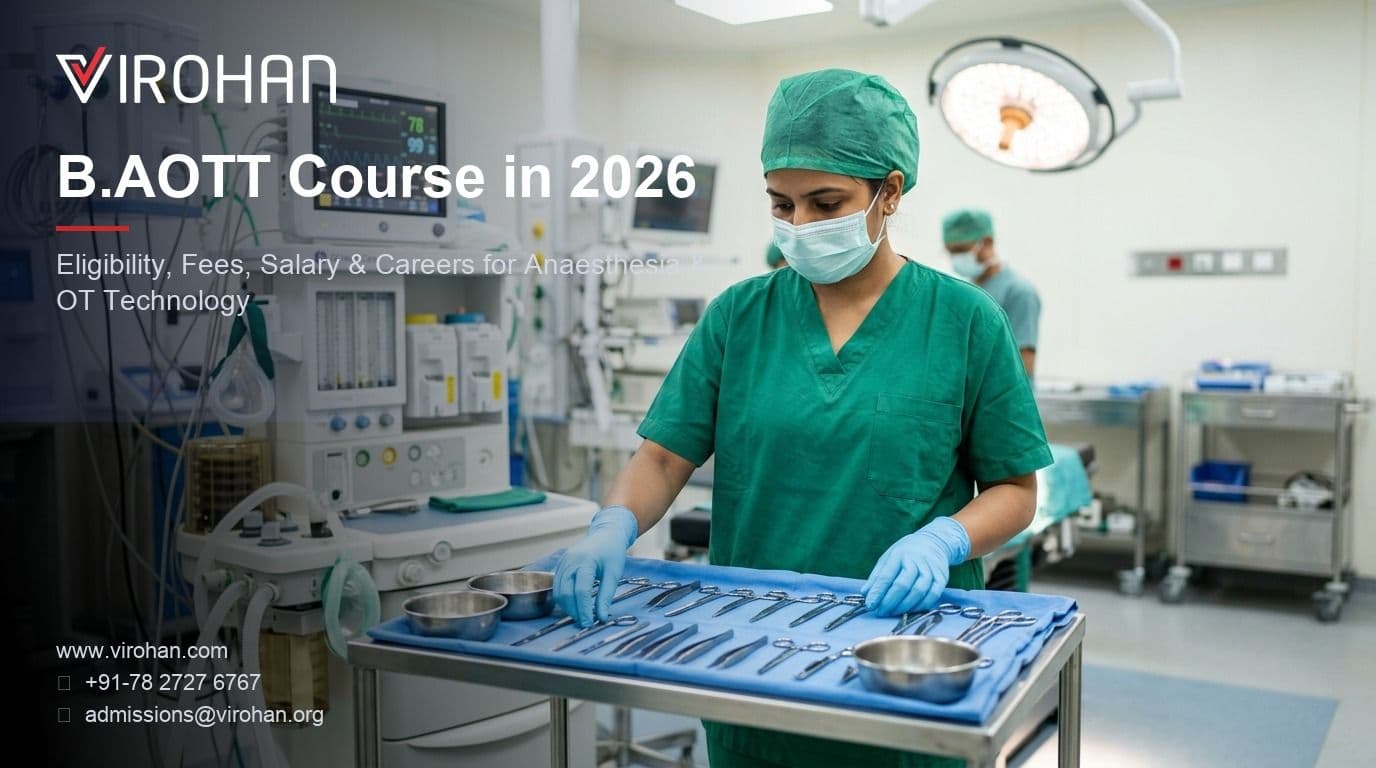
The Bachelor of Anaesthesia & Operation Theatre Technology (B.AOTT) is a four-year undergraduate degree that trains professionals to work alongside anaesthesiologists and surgical teams inside hospital operation theatres. It was formerly known as B.Sc. Anaesthesia and OTT in many institutions. From the 2026-27 academic year, the National Commission for Allied and Healthcare Professions (NCAHP) is moving allied and healthcare programs to standardized degree nomenclature, and B.AOTT is the form being used for this program.
If you are a 12th-pass student researching anaesthesia and OT careers, below are the eligibility, fees, salary, curriculum and career path for B.AOTT, including what to expect when you apply.
B.AOTT Course Information
| Field | Details |
|---|
| Course Name | Bachelor of Anaesthesia & Operation Theatre Technology (B.AOTT) - formerly B.Sc. Anaesthesia and OTT (NCAHP curriculum; notice dated 29.10.2025) |
| Course Level | Undergraduate Degree |
| Course Duration | 4 Years (3 academic + 1 year internship) |
| Admission Process | Merit Based (12th marks) / University Entrance Exam - NEET not required |
| Course Eligibility | 12th pass with 40% in all subjects individually; PCB/PCM mandatory |
| Course Fees | ₹8,60,000 total for the four-year B.AOTT at universities partnering with Virohan, plus ₹10,000 registration (virohan.com) |
| Job Profiles | Anaesthesia Technician, Operation Theatre Technician, Cardiac OT Technician, OT Coordinator, Skin Therapist |
| Annual Salary (Indicative) | Operation Theatre Technician ₹4.5 LPA; OT Incharge ₹8 LPA (AmbitionBox, September 2026) |
What is the B.AOTT Course?
B.AOTT combines anaesthesia technology and operation theatre technology into a single four-year undergraduate degree. The first three years are academic - anatomy, physiology, pharmacology, anaesthesia equipment, OT instrumentation, sterilisation protocols, and patient monitoring. The final year is a mandatory 12-month internship inside functioning hospital operation theatres.
Graduates enter the workforce as degree-qualified technologists rather than diploma-level assistants. They prepare anaesthesia and OT equipment, monitor patient vitals during surgery, support the anaesthesiologist through induction and recovery, and ensure the surgical environment meets sterility and safety standards. That safety work matters: the World Health Organization notes that complications after inpatient operations occur in up to 25% of patients.
Universities have historically offered this degree under different names - B.Sc. Anaesthesia, B.Sc. OTT, or B.Sc. Anaesthesia & OT Technology - with varying durations and curricula. With NCAHP standardizing allied and healthcare programs under a uniform four-year structure (3 academic years + 1 internship), B.AOTT is now the officially recognized degree name across institutions.
B.AOTT Course Eligibility 2026
Eligibility for B.AOTT:
- Qualifying exam: 10+2 from a recognized board
- Stream: Physics, Chemistry, and Biology (PCB) or Mathematics (PCM) - both are accepted
- Minimum marks: 12th pass with 40% in all subjects individually
- NEET: Not required for B.AOTT
The PCB-or-PCM provision is meaningful - earlier, many universities accepted only PCB. The updated eligibility opens the program to students with strong technical aptitude from the maths stream.
NEET-UG remains mandatory for MBBS, BDS, BAMS, and BHMS. For BPT, NEET has been deferred to AY 2027-28 per the NCAHP letter dated 02 March 2026. B.AOTT does not require NEET.
B.AOTT Course Fees in India
At universities partnering with Virohan, the fee for the four-year B.AOTT is ₹8,60,000, plus a ₹10,000 registration fee, and it is the same figure at every campus that offers the degree (virohan.com). One published figure per campus means you know the full four-year cost before you apply, rather than working from a first-year number.
What the fee covers. Ask what is included before you compare programs. Tuition, laboratory and equipment access, examination charges and the internship year are normally part of the total, while hostel, transport and study materials are usually billed separately. Government institutions are the lower-cost route because state funding carries most of the cost, but seats are few and are allocated through state merit lists and counselling, so it is worth preparing for both routes.
Universities partnering with Virohan give students access to 2,000+ healthcare employer partners across 20+ cities for internship and job opportunities. For the full course breakdown, see the B.AOTT course guide.
Merit-based scholarships for B.AOTT, such as Virohan's Aspire for Healthcare Scholarship, may be available; amounts, eligibility and availability can change, so check the current terms with Virohan's expert counsellors before you apply.
Anaesthesia Technologist Salary in India (2026)
The average column is where most people in the role sit, the top 10% column is what you can reach as you specialize and take charge of a theatre, and the top 1% column is what the strongest earners in the field are on. Where you land depends on the specialty you build, the employer and the city, and the figures are indicative rather than guaranteed.
Salary by Role: What the Career Leads To
| Role | Average annual salary | Top 10% earn above | Top 1% earn above | Source |
|---|
| Operation Theatre Technician | ₹3.1 LPA | ₹4.5 LPA | ₹13.7 LPA | AmbitionBox, September 2026 |
| Anaesthesia Technician | ₹3.0 LPA | ₹5 LPA | ₹6 LPA | AmbitionBox, September 2026 |
| Cath Lab Technician | ₹3.6 LPA | ₹5.1 LPA | ₹12 LPA | AmbitionBox, September 2026 |
| Cardiac Technician | ₹3.1 LPA | ₹4.5 LPA | ₹13 LPA | AmbitionBox, September 2026 |
| Perfusionist (specialist route) | ₹4.3 LPA | ₹6 LPA | ₹13.2 LPA | AmbitionBox, September 2026 |
| OT Incharge (senior route) | ₹6.0 LPA | ₹8 LPA | ₹16.5 LPA | AmbitionBox, September 2026 |
Plan for the senior end, because it is reachable on this degree. Run a theatre as an OT Incharge and you are looking at ₹6 LPA on average, ₹8 LPA in the top 10%, and ₹13 LPA to ₹16.5 LPA among the highest earners across these roles. Those outcomes follow specialization, responsibility for a theatre or a team, or a move into perfusion or cath lab work. These are different career paths rather than automatic steps, so you can also move into a specialty theatre early if an employer hires for it.
Pay also varies by employer type and city. Large private hospital chains in metropolitan areas often pay above the national figures for equivalent experience, while government hospitals follow the Central or State Pay Commission grade structure and offer long-term benefits beyond headline salary. These figures are indicative rather than guaranteed. For a role-by-role career path, see the guide to anaesthesia technologist salary and career path.
B.AOTT Curriculum and Internship Structure
The B.AOTT curriculum is structured across four years:
- Year 1: Human anatomy, physiology, biochemistry, fundamentals of anaesthesia
- Year 2: Pharmacology of anaesthetic agents, OT instrumentation, sterilisation and asepsis, medical electronics
- Year 3: Advanced anaesthesia techniques, perioperative care, ICU and emergency care, applied pharmacology
- Year 4 (Internship): 12-month hospital rotation across general surgery OTs, cardiac and neurosurgery suites, day-care surgical centers, ICU, and emergency departments
The internship is the differentiator. Students who complete a structured rotation across multiple OT environments enter the job market with hands-on exposure to anaesthesia delivery systems, patient monitoring devices, and crisis-response protocols - which is what employers test for in interviews.
Career Opportunities for B.AOTT Graduates
B.AOTT graduates work in roles such as:
- Anaesthesia Technologist - direct support to anaesthesiologists during induction, intra-operative care, and recovery
- Operation Theatre Technician - preparation, sterilization, and instrument management for the surgical suite
- ICU Technologist - patient monitoring and life-support equipment management in critical care units
- Day-Care Surgical Center Technologist - high-volume ambulatory surgery support
- OT Lead / OT Manager - supervisory roles after 5–8 years of experience
- OT Coordinator - coordinating theatre schedules, equipment readiness and technician teams
Employers include multispecialty hospital chains, government tertiary-care hospitals (AIIMS, JIPMER, PGIMER), trauma units, fertility clinics, and stand-alone surgical centers. International roles in Gulf countries (UAE, Saudi Arabia, Qatar) and the UK NHS are accessible after 3–5 years of Indian experience plus relevant licensing.
What the NCAHP Framework Means for B.AOTT
The National Commission for Allied and Healthcare Professions (NCAHP) sets the national framework for allied and healthcare education in India. From AY 2026-27, notified programs move to standardized degree nomenclature, uniform eligibility, and a four-year structure (3 academic years + 1 year internship).
For B.AOTT specifically:
- Standardized degree name: B.AOTT replaces older B.Sc. Anaesthesia / B.Sc. OTT labels at institutions adopting the NCAHP Operation Theatre Technology curriculum (notice dated 29.10.2025)
- Uniform duration: 4 years (3 academic + 1 year internship)
- Eligibility: 12th pass with 40% in all subjects individually; PCB/PCM mandatory
- NEET not required: Selection is by 10+2 merit or university entrance tests
Standardization supports nationwide degree portability and aligns graduates with NCAHP registration requirements, which larger hospitals increasingly expect at hiring.
Where to Study B.AOTT: Universities with Virohan as Industry Partner
When evaluating a B.AOTT program, look for these signals:
- Curriculum aligned to the NCAHP framework for AY 2026-27
- Attached teaching hospital for internship rotations
- Structured 12-month internship with named hospital partners
- Academic teams with active OT experience (not theory-only instructors)
- Internship settings, and the roles graduates take after the degree
Government institutions known for allied and healthcare programs include AIIMS, JIPMER, PGIMER, and KGMU. The universities below offer B.AOTT with Virohan as their industry partner:
| University | Location |
|---|
| BBD University | Lucknow |
| CMR University | Bengaluru |
| HRIT University | Ghaziabad |
| Invertis University | Bareilly |
| Joy University | Kanyakumari |
| Lingaya's Vidyapeeth | Faridabad |
| MIT University | Shillong |
| SR University | Warangal |
| Shobhit University | Saharanpur |
| Silver Oak University | Ahmedabad |
| UPES | Dehradun |
| Vikrant University | Gwalior |
Verify current intake and curriculum alignment directly with each institution.
With nearly a decade in allied and healthcare education, Virohan is an industry partner to higher education institutions; programs are offered by universities with Virohan as their industry partner, not by Virohan. Virohan supports students by giving them access to 2,000+ healthcare employer partners across 20+ cities for internship and job opportunities. Over 13,000 candidates and alumni are pursuing healthcare education and careers through Virohan's network of top universities and healthcare employer partners. Talk to our expert counsellors to explore B.AOTT options.
How to Plan Your B.AOTT Application
If you are evaluating B.AOTT for 2026-27, three practical steps:
- Shortlist 4–5 universities based on curriculum alignment, internship structure, and fees
- Track application deadlines and entrance-test requirements per university
- Talk to our expert counsellors for personalized guidance on choosing the right program and university
Conclusion
B.AOTT prepares you for one of the most hands-on roles in a hospital: supporting anaesthesia and surgical teams in the operation theatre. The four-year degree, with its internship year, equips you to start as an Anaesthesia Technologist or Operation Theatre Technician and to grow towards senior roles such as OT Incharge or specialist routes such as perfusion.
Because eligibility covers both PCB and PCM students and NEET is not required, B.AOTT is open to a wide range of 12th-pass students.