The Policy Shifts Reshaping Healthcare Education
For decades, “Paramedical” has been a familiar, if loosely defined umbrella
term for a wide range of healthcare education programs in India. That chapter
is now formally drawing to a close.
India’s transition from
“Paramedical” to “Allied and Healthcare” marks the beginning
of a more structured, standardised, and nationally aligned approach to allied
health education.
This shift is being guided by the
National Commission for Allied and Healthcare Professions (NCAHP)
- established to bring long-needed clarity, consistency, and credibility to a
sector that has long operated under fragmented standards.
While NCAHP was constituted in 2021, the pace of implementation has gathered
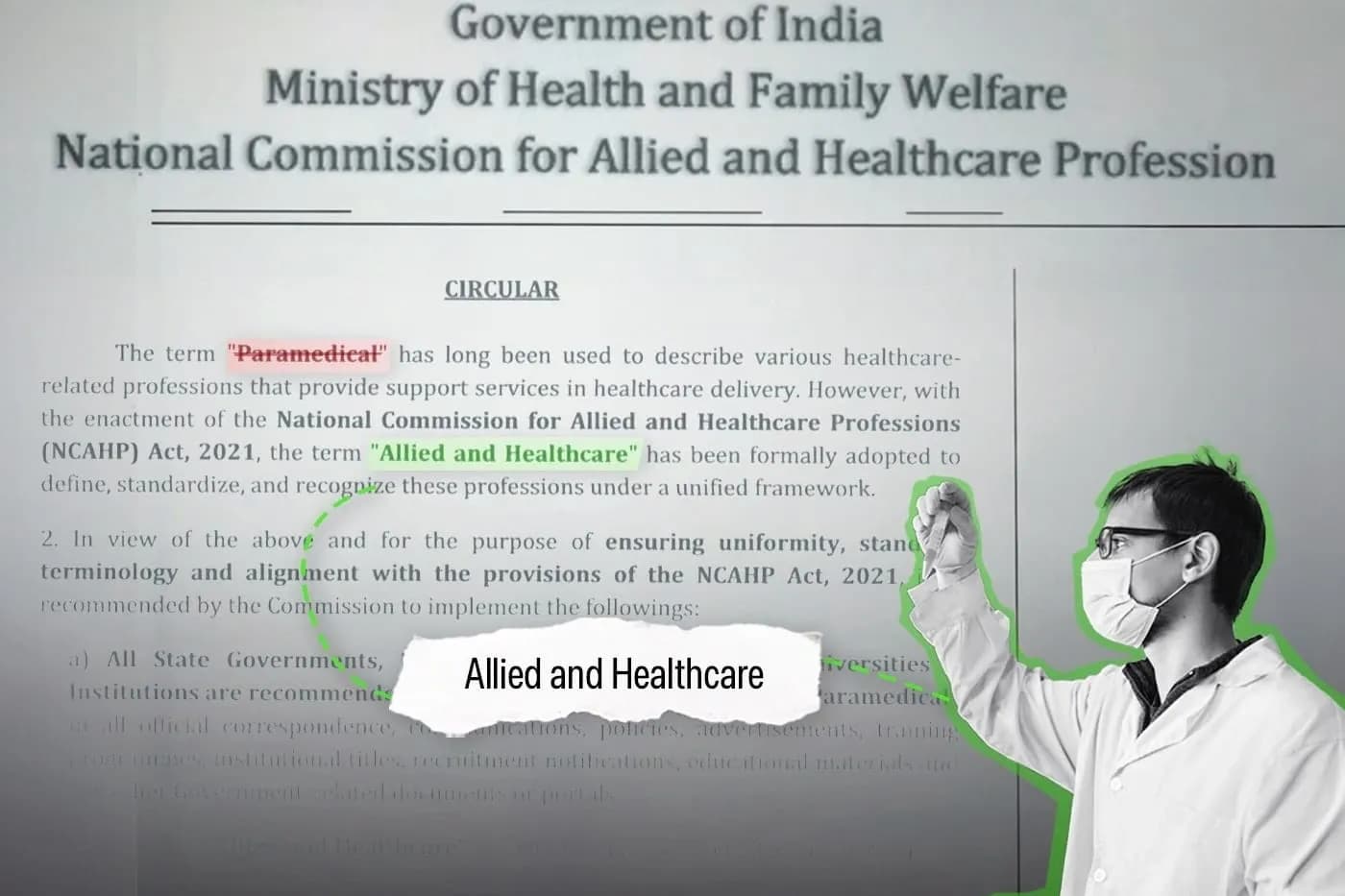
momentum more recently. A key milestone came with the
circular issued on 1 July 2025, which formally anchors the transition from “Paramedical” to “Allied and
Healthcare”.
At first glance, this may seem like a terminology update. However, in
practice, it reflects a deeper structural shift.
What did this Change really Signal?
At its core, this transition indicates:
-
Formal recognition for millions of allied and healthcare
professionals as an integral part of India’s healthcare system.
-
Clearer regulatory framing around how these professions are
defined, trained, and governed
-
Movement towards national alignment, replacing varied
interpretations across institutions and states
Allied health education is no longer positioned as a secondary pathway, but as
a foundational pillar of the healthcare workforce.
What this Means for Institutions
While implementation will continue to evolve, early direction is becoming
clearer:
-
Institutions are expected to gradually discontinue the use
of the term “Paramedical” across official communications, including program
names, prospectuses, advertisements, recruitment notices, and educational
materials.
-
Program nomenclature, curriculum design, and learning outcomes
will increasingly be expected to align with NCAHP-recognised allied and
healthcare roles.
The Virohan Perspective
We see this transition as the foundation for a more mature and accountable
allied health ecosystem.
Institutions that view this phase as a strategic realignment, rather than a
reactive compliance exercise, are more likely to shape the next decade of
healthcare education in India.