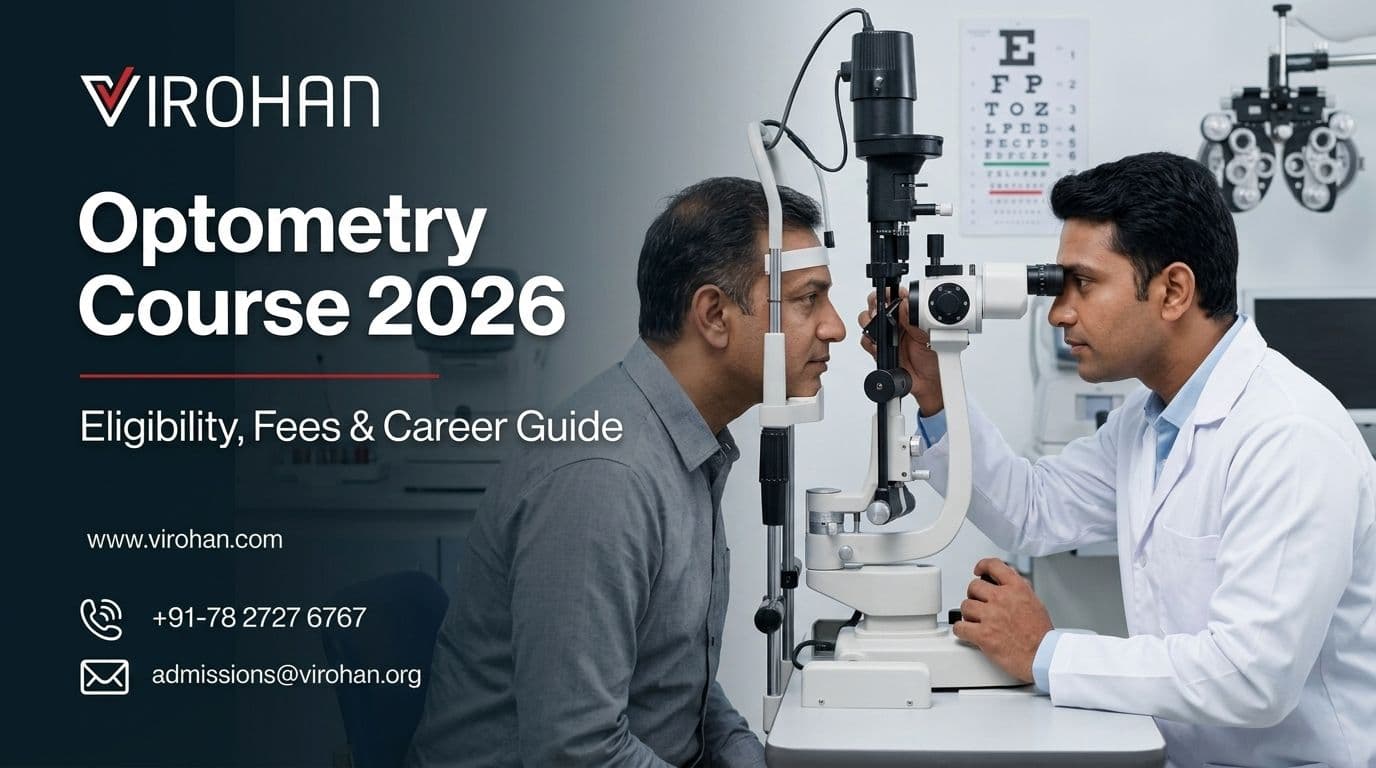
The Bachelor of Optometry (B.Optom) is a 5-year undergraduate degree, 4 academic years plus a 1-year internship, that trains you to examine eyes, test vision, prescribe corrective lenses and detect eye conditions. You can apply after 12th with PCB or PCM, and NEET is not required. B.Optom is offered at universities partnering with Virohan as their industry partner, including Lingaya's Vidyapeeth, MIT University and Vikrant University.
India has a significant vision-care need. The National Blindness and Visual Impairment Survey (2015-19) found that cataract and uncorrected refractive error are the leading causes of visual impairment in the country, and uncorrected refractive error is exactly the problem optometrists are trained to find and correct.
For students who want a career that offers clinical depth, stable employment, and long-term growth, the Bachelor of Optometry (B.Optom) is the recognised undergraduate pathway. This guide covers eligibility, course structure, fees, career scope, salary expectations, and the regulatory changes shaping optometry education in India in 2026.
Optometry Course (B.Optom) Information
| Field | Details |
|---|
| Course Name | Bachelor of Optometry (B.Optom) |
| Course Level | Undergraduate Degree |
| Course Duration | 5 years (4 academic + 1 year internship), as notified by NCAHP |
| Admission Process | Merit Based on 10+2 marks; some universities conduct their own entrance test. NEET not required (NCAHP Optometry curriculum) |
| Course Eligibility | 12th pass with 40% in all subjects individually; minimum 50% in PCB/PCM; minimum age 17 |
| Course Fees | Varies by university; check the current total program fee at universities partnering with Virohan on virohan.com/courses |
| Job Profiles | Contact Lens Specialist, Pediatric Optometrist, Refractive Surgery Coordinator, Low Vision Rehabilitator, Research Optometrist |
| Average Annual Salary | ₹2.4 LPA to ₹6.1 LPA (entry-level average to top 1% for optometrists; Indeed India February 2026, AmbitionBox September 2026) |
What is Optometry?
Optometry is the allied and healthcare profession focused on examining eyes, diagnosing vision problems, prescribing corrective lenses, detecting eye diseases, and managing non-surgical eye care. Optometrists are primary eye-care providers who work alongside ophthalmologists to deliver full vision-care services.
Optometrists do not perform eye surgery. Their scope includes:
- full eye examinations and vision testing
- prescribing spectacles and contact lenses
- detecting conditions like glaucoma, cataracts, diabetic retinopathy, and macular degeneration
- managing refractive errors, binocular vision problems, and low-vision rehabilitation
- providing pre- and post-operative care for eye surgeries
- community eye-health screening and education
Optometry is formally recognised as an allied and healthcare profession under the National Commission for Allied and Healthcare Professions (NCAHP) Act 2021. NCAHP notified the competency-based Optometry curriculum on 24 April 2025, with a corrigendum issued on 29 October 2025. This places B.Optom within a regulated career framework with clear professional standards and degree pathways.
Optometrist vs Ophthalmologist vs Optician
Understanding the distinction between these three roles helps you make the right career choice.
| Role | Qualification | Core scope | Performs surgery |
|---|
| Optometrist | B.Optom (5 years) | Eye exams, vision testing, prescribing lenses | No |
| Ophthalmologist | MBBS + MS/MD Ophthalmology | Medical diagnosis, medication, eye surgery | Yes |
| Optician | Certificate or diploma | Dispensing and fitting eyewear | No |
Each role has its own training and scope. If you want clinical eye-care work built on a 5-year degree, optometry is the route, and you can apply after 12th without NEET.
What is B.Optom?
The Bachelor of Optometry (B.Optom) is the recognised undergraduate qualification for optometry practice in India. As notified by NCAHP (notice dated 24 April 2025, corrigendum 29 October 2025), B.Optom is a 5-year program: 4 years of academic learning followed by a 1-year internship. This structure is standardised under the NCAHP Optometry curriculum and applies across institutions offering the program.
A strong B.Optom program covers:
- foundational sciences: ocular anatomy, physiology, optics, biochemistry
- clinical sciences: refraction, ocular disease, pharmacology, ophthalmic instruments
- specialization: contact lens practice, binocular vision, paediatric optometry, low-vision rehabilitation
- community eye health and outreach
- supervised clinical rotations in eye-care departments
B.Optom Course Duration
B.Optom is a 5-year program under the NCAHP-notified curriculum.
| Program | Duration | Where it sits |
|---|
| Bachelor of Optometry (B.Optom) | 5 years (4 academic + 1 year internship) | NCAHP-notified UG curriculum (24.04.2025; corrigendum 29.10.2025) |
| Master of Optometry (M.Optom) | 2 years | Postgraduate; NCAHP registration required |
B.Optom Eligibility 2026-27
The eligibility for B.Optom at universities partnering with Virohan is:
| Criterion | Requirement |
|---|
| Qualifying exam | Senior Secondary (10+2) from a recognised board |
| Stream | Physics, Chemistry, and Biology or Mathematics (PCB or PCM) |
| Minimum marks | 12th pass with 40% in all subjects individually; minimum 50% in PCB/PCM |
| Age | Minimum 17 by the intake cut-off |
| Entrance exam | NEET not required; admission is merit-based on 10+2 marks, and some universities conduct their own test |
| Documents | 10th and 12th mark sheets, ID proof, medical fitness certificate |
Most universities partnering with Virohan ask for 40% in each individual subject; UPES asks for 50% in each subject. Confirm the requirement for the university you choose with Virohan's expert counsellors.
Exploring other allied and healthcare careers after 12th? See our guide to allied and healthcare courses after 12th.
Course Structure and Curriculum
The B.Optom curriculum progresses from foundational sciences to advanced clinical specialization.
Year 1, Foundations: Ocular anatomy, physiology, general anatomy, physics of optics, biochemistry, and basic clinical skills. You build the scientific foundation for clinical practice.
Year 2, Core Clinical Sciences: Visual optics, refraction techniques, ophthalmic instruments, ocular diseases, pharmacology, and low-vision aids. You begin hands-on work with testing equipment.
Year 3, Specialization: Contact lens practice, binocular vision, paediatric optometry, geriatric optometry, community eye health, and ocular disease management. Clinical postings in hospital eye departments begin.
Year 4, Advanced Clinical Practice: Advanced diagnostics, sports vision, occupational vision, research methodology, and integrated patient management.
Year 5, Internship: A full year of supervised practice in eye hospitals and community settings, where you apply classroom learning to real patient cases. The internship is a structural requirement under the NCAHP-notified Optometry curriculum and is central to developing diagnostic confidence and clinical judgement.
Core skills developed include retinoscopy, subjective refraction, slit-lamp examination, tonometry, fundus examination, contact lens fitting, vision therapy, and low-vision assessment.
Why the NCAHP Framework Matters for Optometry Students
Until recently, optometry education in India varied considerably in duration, curriculum, and quality. The NCAHP Act 2021 changed this. By notifying a standardised degree structure, eligibility criteria, and a competency-based curriculum for B.Optom, NCAHP has established a national baseline for institutions.
What this means practically for you:
Curriculum quality is now standardised. NCAHP has released a competency-based curriculum for optometry that institutions are required to adopt. Check that your chosen institution follows this curriculum in practice.
Optometry is a regulated profession with defined standards. It has professional accountability and long-term relevance as a first-choice healthcare career.
NCAHP registration becomes the professional credential. Admission to PG programs in optometry requires NCAHP registration. As the profession formalises, registration will increasingly matter for career advancement, independent practice, and employer recognition.
Universities partnering with Virohan follow the NCAHP-notified curriculum, so you enter the profession on the right foundation.
B.Optom Course Fees in India
B.Optom fees are quoted as a total for the full 5-year program and depend on the institution, infrastructure, clinical training model, and location. Government-funded colleges usually charge less than private universities.
Factors that affect fees:
- institution location and type (government vs private)
- campus infrastructure and lab facilities
- clinical exposure model and hospital tie-ups
- student support services
Check the current total program fee for B.Optom at universities partnering with Virohan on virohan.com/courses, or talk to our expert counsellors. Merit-based scholarships may be available; amounts, eligibility and availability can change, so check the current terms before you apply. When comparing programs, prioritise UGC-approved degrees from NAAC-accredited institutions, and factor in clinical exposure alongside the total fee.
For a broader view of earning potential across allied and healthcare careers, see our guide to the best healthcare degrees for high salary careers.
Optometrist Salary in India (2026)
Salary after B.Optom varies by employer type, location, specialization, and experience.
| Source | Headline figure | Notes |
|---|
| AmbitionBox (September 2026) | Average ₹3.5 LPA | Top 10% earn above ₹4.4 LPA; top 1% above ₹6.1 LPA |
| Indeed India (February 2026) | Mean monthly ₹20,174 | Based on 300 reported salaries; equivalent to about ₹2.4 LPA |
The spread reflects different segments of the market: entry and retail roles sit near the Indeed figure, while experienced clinical and specialist roles sit toward the upper AmbitionBox bands.
Top-paying cities for optometrists (Indeed India, February 2026, monthly):
| City | Average Monthly Salary |
|---|
| Pune, Maharashtra | ₹22,998 |
| Mumbai, Maharashtra | ₹22,600 |
| Hyderabad, Telangana | ₹22,414 |
| Chennai, Tamil Nadu | ₹21,870 |
| Bengaluru, Karnataka | ₹21,764 |
Higher-paying employers (Indeed India, February 2026):
| Employer | Annual Salary |
|---|
| Sankara Nethralaya | ₹4,20,000 |
| Lawrence & Mayo | ₹3,48,000 |
| Himalaya Optical | ₹2,76,149 |
Large eye-hospital networks and metros tend to pay more for equivalent experience, and qualified Indian optometrists also find roles in Gulf countries, the UK and Southeast Asia after gaining experience and the required licensing.
Salary figures are indicative rather than guaranteed. Focus on building clinical depth and practical skills during the degree.
Career Scope After B.Optom
Vision-care needs across India create sustained demand for qualified optometrists in several settings.
Hospitals and Eye-Care Centres: Eye hospitals and multi-specialty hospitals employ optometrists to support ophthalmology departments by conducting exams, managing outpatient clinics, and assisting in pre- and post-operative care.
Eye-Care Chains: Retail eyewear and optical chains hire optometrists for in-store consultation and vision testing. These roles offer structured hours and clear career progression.
Independent Practice: Experienced optometrists open their own clinics, particularly in tier-2 and tier-3 cities where specialised vision care is scarce.
Corporate Wellness and Occupational Health: Larger organisations hire optometrists for employee vision screening, particularly in manufacturing and IT.
Community Eye Health: Community-based roles in outreach, screening camps, and rural health programs are a meaningful career pathway.
Research and Academia: M.Optom graduates can pursue research in visual science, clinical trials for new optical technologies, or teaching positions in optometry colleges.
Common Misconceptions About Optometry
Myth 1: "Optometrists are just glasses sellers." Modern optometry involves complex clinical skills including disease detection, binocular vision management, paediatric care, and low-vision rehabilitation. Retail dispensing is one small part of a much broader clinical profession.
Myth 2: "There is no career growth in optometry." B.Optom and M.Optom graduates can specialise in contact lens practice, low-vision rehabilitation, sports vision, or paediatric optometry, and experienced practitioners can run their own clinics.
Myth 3: "Short-term courses are enough to become an optometrist." With NCAHP formalising degree standards, the recognised B.Optom degree is the pathway for professional registration, hospital employment, and PG admission.
Myth 4: "NEET is required for optometry." NEET is not required for B.Optom. Admission is on the basis of PCB or PCM merit in Class 12.
Also exploring other allied and healthcare pathways? Compare with medical radiology and imaging technology and anaesthesia and operation theatre technology.
Where to Study B.Optom: Universities with Virohan as Industry Partner
Virohan has nearly a decade in allied and healthcare education as an industry partner to higher-education institutions. Its 2,000+ healthcare employer partners across 20+ cities give a clear view of what employers need from optometry graduates.
Students at universities partnering with Virohan get access to structured clinical rotations, healthcare industry partners across hospitals and diagnostic centres for internship and job opportunities, and essential communication, leadership, digital literacy, and English language skills. Over 13,000 candidates and alumni are pursuing healthcare education and careers through Virohan's network of top universities and healthcare employer partners.
Universities partnering with Virohan that offer B.Optom include:
Each university awards its own UGC-approved degree, with Virohan as industry partner.
How to Plan Your B.Optom Application
If you are evaluating B.Optom programs for 2026-27:
- Shortlist universities based on NCAHP-curriculum alignment, clinical exposure, and total program fees
- Track application deadlines and any university-specific entrance-test requirements
- Talk to our expert counsellors for guidance on the program and university that fit you
Conclusion
The Bachelor of Optometry is one of the most clinically meaningful allied and healthcare careers available to students after 12th. Vision-care needs across India keep qualified optometrists in demand.
With NCAHP now standardising the degree structure, eligibility, and professional registration requirements, students entering B.Optom in 2026-27 are joining a profession with clearer pathways and stronger employer recognition.
Key takeaways:
- B.Optom is a 5-year program (4 academic + 1-year internship), as notified by NCAHP (24.04.2025; corrigendum 29.10.2025)
- Eligibility is 12th pass with 40% in all subjects individually and a minimum 50% in PCB/PCM, with a minimum age of 17
- NEET is not required for B.Optom
- Universities partnering with Virohan that offer B.Optom include Lingaya's Vidyapeeth, MIT University, Joy University, HRIT University and Vikrant University
For more healthcare career options, explore our guides on BMRIT (radiology and imaging technology), the physiotherapy course, and the best lab technician courses in India.
Interested in B.Optom programs at universities partnering with Virohan? Talk to our expert counsellors to understand the degree structure, clinical exposure, and career outcomes.