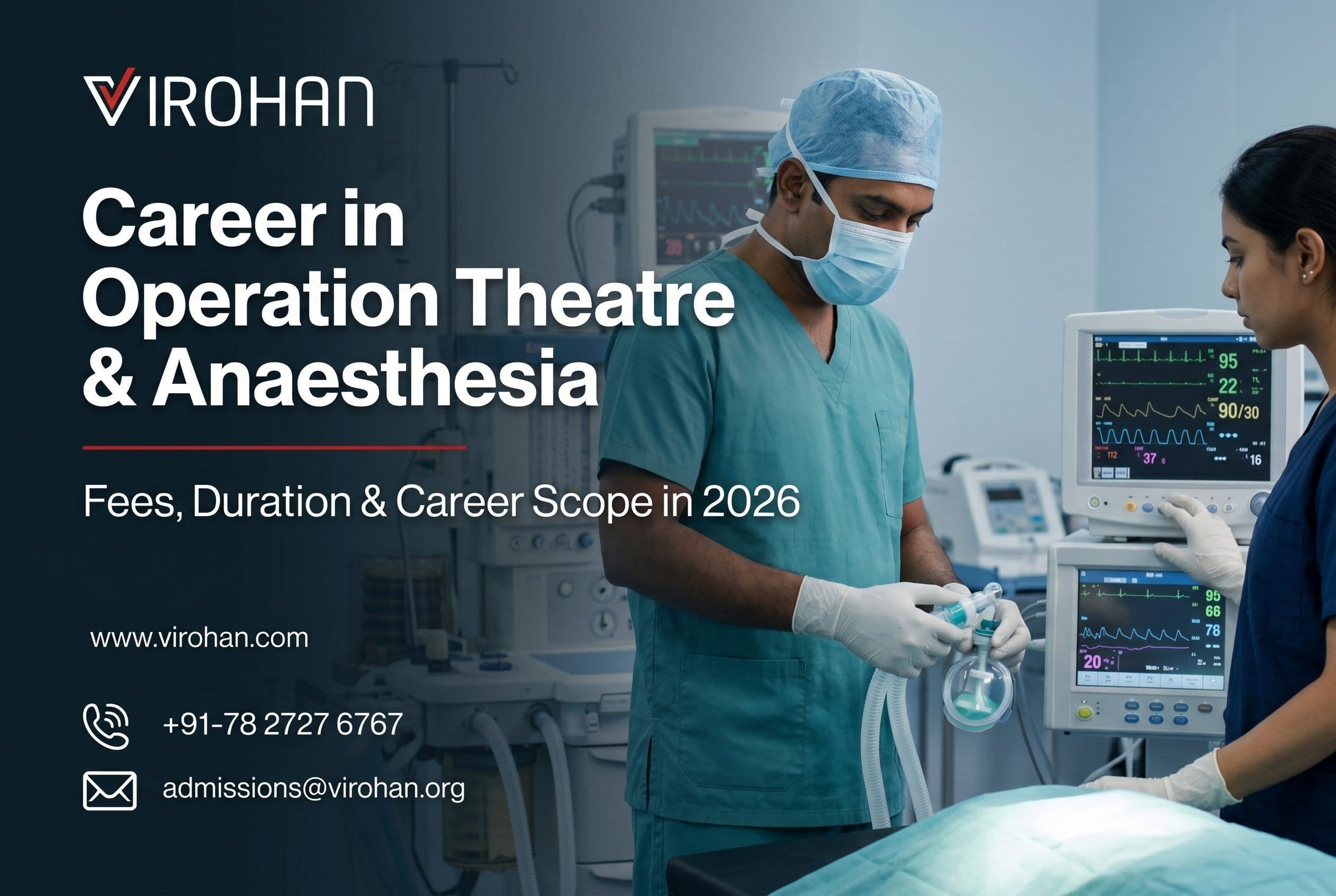
Anaesthesia Technologists (also spelled Anesthesia Technologists) play a vital role in surgical teams across India. They assist anaesthesiologists with complex equipment setup, continuous patient monitoring, and strict safety protocols. The Indian healthcare sector is expanding rapidly, creating an unprecedented demand for skilled professionals in the operation theatre.
In 2026, rising surgical volumes and stricter national regulation are boosting both demand and career visibility for these professionals. Today, anaesthesia technology is a highly technical career path that benefits from formal degree-level education. This article covers daily roles, indicative salary ranges, and long-term career trajectories in the field. You will also learn how Bachelor of Anaesthesia & Operation Theatre Technology (B.AOTT) programs at universities partnering with Virohan as their industry partner prepare students for this fast-paced clinical environment.
Current Roles of Anaesthesia Technologists
The daily responsibilities of an anaesthesia technologist go far beyond simply handing tools to a doctor. They are highly trained clinical experts who manage the technical environment of the surgical suite. Before any surgery begins, these professionals prepare and calibrate complex anaesthesia delivery systems. They ensure ventilators, defibrillators, and specialized monitors function perfectly.
During the procedure, technologists monitor patient vitals continuously. They watch for minute changes in blood pressure, oxygen levels, and heart rate, instantly alerting the surgical team to any distress. They also assist directly in emergency airway management, a critical skill when seconds matter.
Anaesthesia technologists work inside the physician-led anaesthesia and surgical-care environment, where equipment readiness, monitoring discipline, and sterile protocols all affect patient safety. After surgery, they sterilize and maintain the delicate equipment, preparing the theatre for the next patient.
Anaesthesia Technologist Salaries in 2026
Earnings in this field have grown steadily as the role has become more technical and regulated. For fresh graduates entering the workforce in 2026, indicative entry-level salaries range from ₹3 Lakhs to ₹5 Lakhs per annum. This starting bracket depends heavily on the hiring institution and the city.
Professionals with three to five years of clinical experience typically see their salaries rise to the ₹6 Lakhs to ₹10 Lakhs per annum range. Several factors influence this pay scale. Technologists working in massive corporate hospital chains in metro cities generally earn more than those in smaller regional clinics. Securing advanced certifications in specific surgical sub-specialties also boosts earning potential significantly.
At the top end of the spectrum, the highest reported pay for specialized anaesthesia roles in India reaches ₹20 LPA. Government hospitals offer excellent job security and structured pay scales, but private sector corporate hospitals often provide higher starting packages and faster promotion tracks for highly skilled technologists.
Salary by Experience Tier (India, 2026)
| Experience Tier | Years | Indicative Annual Salary | Typical Setting |
|---|
| Entry-level | 0–2 years | ₹3 – ₹5 LPA | Junior tech roles, tier-2 city hospitals, day-surgery centres |
| Mid-career | 3–5 years | ₹6 – ₹10 LPA | Corporate hospital OT teams in metros, multispecialty units |
| Senior | 6–10 years | ₹10 – ₹15 LPA | Lead technologist roles, sub-specialty units (cardiac, neuro) |
| Specialist / Lead | 10+ years | ₹15 – ₹20 LPA | OT supervisor, clinical educator, transplant/cardiac specialist |
Ranges synthesized from PayScale India and AmbitionBox reported salaries, May 2026. Actual pay varies by employer, city, shift premium, and certifications.
NCAHP Developments Shaping the Profession
The regulatory landscape for allied and healthcare education changed completely with the National Commission for Allied and Healthcare Professions (NCAHP) Act. The commission has formally moved away from outdated terms, replacing them with standardized professional titles.
The B.AOTT pathway is a four-year undergraduate degree structure, with three years of academic study followed by one year of mandatory clinical internship. As of April 2026, NCAHP has not yet published a notified curriculum specifically for Anaesthesia & Operation Theatre Technology, so institutions follow university-designed curricula pending NCAHP standardization.
For B.AOTT programs at universities partnering with Virohan as their industry partner, eligibility is 12th pass with 40% in all subjects individually; PCB/PCM mandatory. NEET is not required for B.AOTT in AY 2026-27.
Why does this regulation matter? It moves allied and healthcare education toward clearer national standards. It also gives students a more future-ready credential than short-format diploma routes. Furthermore, NCAHP registration is becoming important for postgraduate applications across allied and healthcare programs from AY 2026-27.
Where to Study B.AOTT - Universities with Virohan as Industry Partner
Choosing the right educational institution is the first step toward a successful career in the operation theatre. You need a university-led B.AOTT program that puts heavy emphasis on practical skills and stays ready to align with future NCAHP standardization.
Students can pursue B.AOTT programs at universities partnering with Virohan as their industry partner, including CMR University, HRIT, MIT Shillong, Silver Oak University, and Vikrant University.
The training focuses heavily on industry alignment. Students do not just read about anaesthesia machines in textbooks. They practice on modern equipment and learn current hospital protocols. Through this industry-partner model, students gain access to 2,000+ healthcare employer partners across 20+ cities for internship and placement opportunities. If you want to explore these degree options and find the right campus for your goals, talk to our expert counsellors for personalized guidance.
Career Growth and Advancement Opportunities
The career trajectory for a B.AOTT graduate is highly structured and rewarding. You typically start as a junior technologist, handling basic equipment setup and shadowing senior team members. Within two to four years, you can advance to a senior technologist role, taking on independent monitoring duties during complex surgeries.
Specialization is the key to unlocking higher salary brackets. Many technologists choose to focus entirely on cardiac anaesthesia, neurosurgery, or pediatric perioperative care. These high-stakes environments require advanced technical skills and offer strong compensation potential.
Beyond the operation theatre, experienced professionals often move into supervisory roles, managing teams of technicians and technologists. Others transition into clinical educator positions, training the next generation of allied and healthcare students. With the new NCAHP regulations, pursuing postgraduate degrees in hospital management or advanced clinical sciences is now a streamlined process.
What This Means for Aspirants
For students evaluating their career options in 2026, the anaesthesia technologist path offers a practical clinical route into operating-room work. India's healthcare infrastructure is growing, and expanding surgical departments need trained professionals who can manage OT workflows, equipment checks, sterile-field discipline, and patient-monitoring support.
Use job-board searches only as a live demand signal because vacancy counts change daily. Instead of relying on one static count, students should review current openings for anaesthesia technologist, operation theatre technologist, and OT assistant roles while comparing degree options.
When you complete a degree-level B.AOTT program, your earning potential depends on city, employer, shift exposure, certifications, and clinical competence. Formal training can support stronger hiring conversations because hospitals increasingly prefer candidates who understand modern OT and anaesthesia workflows.
Virohan has been working in the allied and healthcare education space for nearly a decade. Programs at universities partnering with Virohan as their industry partner combine academic learning with practical exposure, helping students build confidence with sterile-field protocols, ventilator calibration, and OT workflows. This practical competence can support stronger internship and placement conversations.
What's Next: 2026 Growth Outlook
The future of the anaesthesia technologist profession is tied to hospital expansion, surgical volumes, and the growing complexity of perioperative care. These factors support steady demand for trained operation theatre professionals.
Technology is also reshaping the daily workflow. Artificial intelligence and advanced monitoring tools are becoming standard in modern surgical suites. Technologists who master these new digital interfaces will be highly sought after. Modern hospitals are already using Anaesthesia Quality Indicators to measure technologist performance, shifting the focus from basic equipment maintenance to active patient outcome improvement.
To reach the highest salary tiers, continuous learning is essential. Upskilling through specialized certifications allows you to command premium pay packages. Keep a close eye on future NCAHP announcements, as the commission continues to expand curricula and define new advanced practice roles for allied and healthcare professionals.
Conclusion
Pursuing a career as an anaesthesia technologist in 2026 offers strong earnings growth, immense job satisfaction, and long-term stability. The shift toward degree-level B.AOTT education helps students build the clinical exposure that modern hospitals expect. By choosing programs at universities partnering with Virohan as their industry partner, you gain practical skills and access to healthcare employer networks that can support your early career.