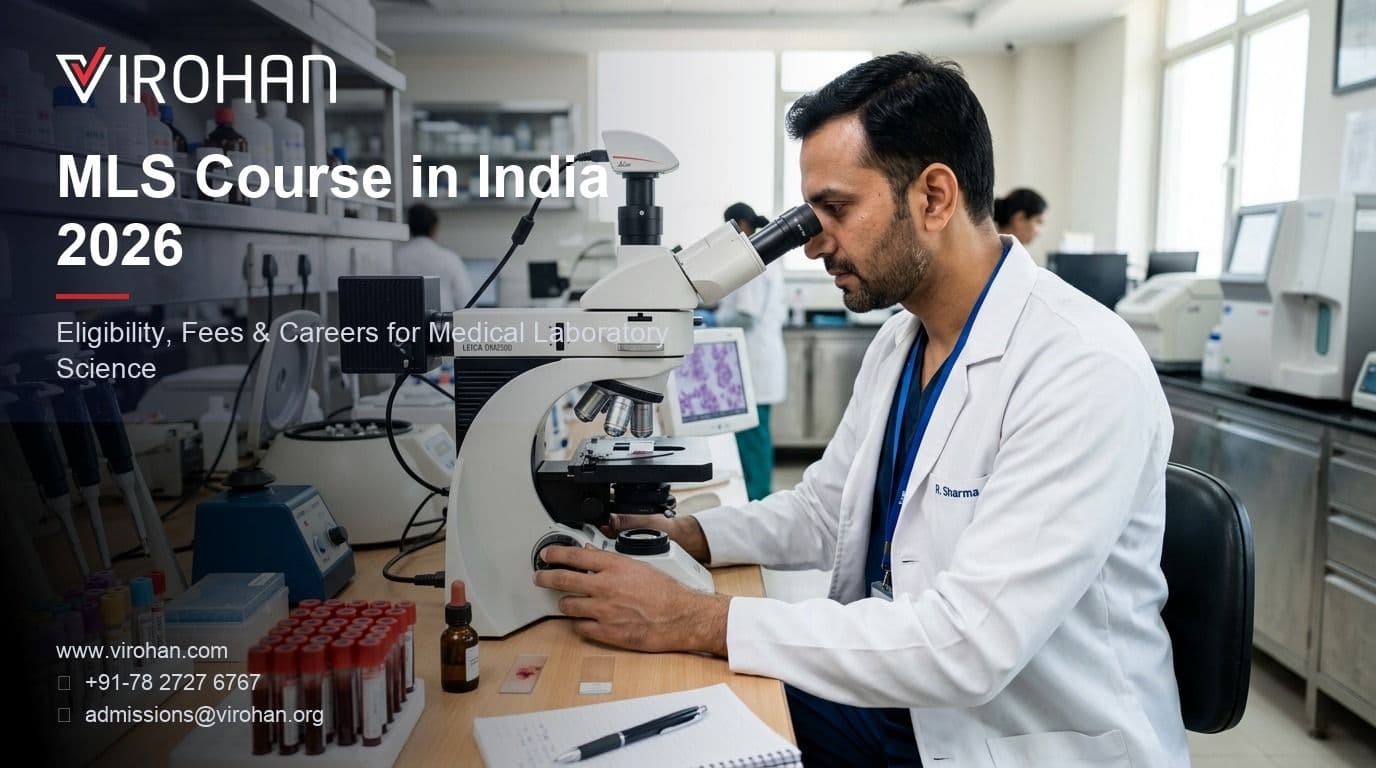
Lab investigations play a central role in clinical decisions. Every blood test, biopsy, microbiology culture, and genetic screen passes through the hands of a medical laboratory scientist before a clinician acts. As India's diagnostic infrastructure expands and the National Commission for Allied and Healthcare Professions (NCAHP) formalizes the profession, the Bachelor of Medical Laboratory Science (B.MLS) has become the standard four-year UG pathway for aspiring lab professionals.
Below is what the B.MLS degree in India involves: eligibility and fees, how the curriculum is structured, and the careers it leads to after graduation. If you have been searching for a BSc MLT or BMLT course, B.MLS is the NCAHP name for that four-year degree. Industry partner Virohan connects students with NCAHP-aligned B.MLS programs at universities partnering with Virohan across India.
Medical Lab Science (B.MLS) Course Information
| Field | Details |
|---|
| Course Name | Bachelor of Medical Laboratory Science (B.MLS) |
| Course Level | Undergraduate Degree |
| Course Duration | 4 years (3 academic + 1 year clinical internship) |
| Regulatory framework | NCAHP-notified MLS curriculum, AY 2026-27 onwards |
| Admission Process | Merit-based (10+2) / institution-specific entrance - NEET not required |
| Eligibility | 12th pass with 40% in all subjects individually; PCB mandatory |
| Course Fees | ₹8,60,000 total for the four-year B.MLS at universities partnering with Virohan, plus ₹10,000 registration (virohan.com) |
| Job Profiles | Entry-level:Medical Laboratory Technologist, Haematology Technologist, Microbiology Technologist, Histopathology Technologist. With experience/PG:Molecular Diagnostics Specialist, Lab Quality Lead |
| Average Annual Salary | Laboratory Technologist ₹3 LPA average; Laboratory Manager ₹8.5 LPA, with the top 10% above ₹20.8 LPA (AmbitionBox, September 2026) |
What Is Medical Laboratory Science?
Medical laboratory science is the discipline that diagnoses disease through the analysis of blood, tissue, body fluids, and other biological samples. A medical laboratory technologist runs and interprets those analyses, from preparing samples and operating analyzers to validating results against quality controls, flagging critical values to clinicians, and signing off on reports that drive treatment decisions.
When a patient is suspected of dengue, leukaemia, sepsis, or a thyroid disorder, the diagnostic call is made in the lab. Lab professionals work across hospital diagnostic laboratories, diagnostic chains, blood banks and transfusion centers, public health laboratories, research and IVF labs, and the in-vitro diagnostics (IVD) industry.
A B.MLS graduate understands the science behind every assay, the quality systems that support accuracy, and the clinical relevance of each result. This is the level the NCAHP framework is now standardizing across the country.
NCAHP-Notified MLS Curriculum: Why It Matters
Until recently, lab education in India was fragmented across short certificates, two-year diplomas, and various university-designed degrees, each with its own curriculum and quality bar. NCAHP, the statutory body established under the NCAHP Act 2021, has changed this for medical laboratory science.
NCAHP notified a competency-based MLS curriculum with a Corrigendum-1 update listed on the NCAHP Important Letters page. From AY 2026-27 onwards, institutions offering NCAHP-recognized B.MLS programs are required to follow the notified curriculum, the standardized four-year (3+1) structure, and the common nomenclature.
For aspirants, the practical implications are three:
- Standardized quality across universities. A B.MLS earned at one NCAHP-aligned university is comparable to one earned at another. Competencies, internship requirement, and exit standards are common.
- Clearer credential for employers. Hospitals and diagnostic chains can recruit against a defined national standard rather than evaluating disparate diploma and degree titles.
- PG and registration ready. NCAHP registration is becoming mandatory for postgraduate entry in allied and healthcare professions. A B.MLS positions you well for PG study, senior roles, and potential recognition abroad as the framework gains acceptance.
The four-year B.MLS is the NCAHP-notified undergraduate degree in medical laboratory science. For aspirants who want the full undergraduate qualification, with the registration, postgraduate and specialist options that come with it, the four-year B.MLS at an NCAHP-aligned university is the route to choose.
MLS Eligibility and Admission for 2026-27
Eligibility follows the NCAHP-notified curriculum:
- 12th pass with 40% in all subjects individually
- PCB mandatory
- Admission on merit; some institutions run their own entrance tests
NEET is not required for B.MLS. NCAHP has specified NEET for BPT, and that requirement has been deferred to AY 2027-28. For other allied and healthcare programs - including B.MLS - admission is merit-based at the institution level.
For a fuller eligibility breakdown including documentation and application timing, see our UG Degree in MLT guide.
Curriculum Structure: 3 Years Academic + 1 Year Clinical
The B.MLS spans eight semesters of coursework followed by a 12-month full-time clinical internship in a teaching hospital's diagnostic laboratories.
Year 1 - Foundations. Human anatomy and physiology, general biochemistry, basic pathology, introduction to microbiology, lab safety and quality systems, communication and professional English.
Year 2 - Core lab sciences. Clinical haematology, clinical biochemistry, medical microbiology, immunology and serology, instrumentation and lab techniques.
Year 3 - Advanced lab sciences and clinical labs. Clinical pathology, histopathology and cytology, molecular diagnostics and biotechnology, transfusion science (blood banking), parasitology and mycology, quality assurance and laboratory management, research methodology.
Year 4 - Clinical internship. Twelve months of supervised practice rotating through haematology, biochemistry, microbiology, histopathology, blood bank, and immunology departments. Interns log cases under qualified pathologists and senior medical laboratory scientists.
The internship year is integral to the four-year program. For semester-by-semester subjects and a deeper breakdown of practicals, see our companion B.MLS guide.
Career Progression in Medical Laboratory Science
Career growth for an MLS graduate is generally structured and steady, with emerging technical and managerial tracks across diagnostic chains and hospitals:
- Junior Medical Laboratory Technologist (often 0–2 years) - runs routine assays under supervision, learns instruments and SOPs.
- Medical Laboratory Technologist (often 2–5 years) - owns sections of the workflow, validates complex results, handles internal QC, and mentors juniors.
- Section In-charge / Senior Technologist (often 5–8 years) - leads a department such as haematology, microbiology, histopathology, or blood bank, and owns turnaround times and accreditation readiness.
- Lab Manager / Quality Lead (often 8+ years) - oversees operations across sections or sites, manages NABL compliance, audits, and procurement.
- Specialist tracks - molecular diagnostics, cytogenetics, transfusion medicine, infection-control surveillance.
- Adjacent paths - IVD industry, lab-equipment sales, clinical research, public health surveillance, and lecturer roles at allied and healthcare institutions.
Specialization is the lever. Two MLS graduates with the same five years of experience can sit in different pay bands depending on whether one moved into molecular diagnostics or stayed in routine biochemistry.
Postgraduate Study and Specialization
A B.MLS opens several PG routes - Master of Medical Laboratory Science (MMLS) with specialization in haematology, clinical biochemistry, microbiology, histopathology, or molecular diagnostics; MSc in Molecular Diagnostics or Cytogenetics; MSc in Transfusion Medicine; MHA / MBA in Healthcare Management; and MPH for public health surveillance and program management.
NCAHP registration as a B.MLS is increasingly the gate to PG admissions in allied and healthcare professions. Plan registration alongside graduation rather than after.
Working Abroad as a Medical Laboratory Technologist
International routes typically open after 3–5 years of Indian clinical experience plus the relevant licensing exam - DataFlow verification plus Gulf licensing through DHA Sheryan (Dubai), Department of Health Abu Dhabi (Abu Dhabi; formerly HAAD), or SCFHS (Saudi); HCPC registration as a Biomedical Scientist for the UK NHS; CSMLS for Canada; the AIMS pathway for Australia; and Ministry of Health credentialing via MOH Singapore and the Malaysia Ministry of Health registration portal for Singapore and Malaysia. Specializations in molecular diagnostics, blood banking, and histopathology travel particularly well.
Salary for B.MLS Graduates in India
The average column is where most people in the role sit, the top 10% column is what you can reach as you specialize and move into senior laboratory work, and the top 1% column is what the strongest earners in the field are on. Where you land depends on the specialization you build, the employer and the city, and the figures are indicative rather than guaranteed.
| Role | Average annual salary | Top 10% earn above | Top 1% earn above | Source |
|---|
| Medical Lab Technician | ₹2.6 LPA | ₹4.5 LPA | ₹10 LPA | AmbitionBox, September 2026 |
| Laboratory Technologist | ₹3 LPA | ₹4.1 LPA | ₹10.4 LPA | AmbitionBox, September 2026 |
| Molecular Biologist | ₹3.9 LPA | ₹5 LPA | ₹12 LPA | AmbitionBox, September 2026 |
| Histopathology Technician | ₹4 LPA | ₹5.1 LPA | ₹10.3 LPA | AmbitionBox, September 2026 |
| Lab Incharge | ₹5 LPA | ₹6.6 LPA | ₹13 LPA | AmbitionBox, September 2026 |
| Laboratory Manager | ₹8.5 LPA | ₹20.8 LPA | ₹39 LPA | AmbitionBox, September 2026 |
Specialist bench work in histopathology or molecular diagnostics pays above general technician roles from the start, and if you make it to laboratory management you are looking at ₹8.5 LPA on average and above ₹20.8 LPA in the top 10%, several times the entry figure. Postgraduate study, specialization after the degree and NCAHP registration are the levers that make that progression easier.
These figures are indicative rather than guaranteed. For a comparison of laboratory course levels and what each leads to, see the guide to the best lab technician courses in India.
Fees: What to Expect
At universities partnering with Virohan, the fee for the four-year B.MLS is ₹8,60,000, plus a ₹10,000 registration fee. One published figure per campus means you know the full four-year cost before you apply.
What the fee covers. Ask what is included before you compare programs. Tuition, laboratory and equipment access, examination charges and the internship year are normally part of the total, while hostel, transport and study materials are usually billed separately. Government institutions are the lower-cost route because state funding carries most of the cost, but seats are few and are allocated through state merit lists and counselling, so it is worth preparing for both routes.
For scholarships and education loan options, see our UG Degree in MLT fees guide.
When evaluating fees, confirm the full four-year cost - including internship, lab, and examination charges - not just headline tuition.
Merit-based scholarships for the B.MLS, such as Virohan's Aspire for Healthcare Scholarship, may be available; amounts, eligibility and availability can change, so check the current terms with Virohan's expert counsellors before you apply.
Where to Study B.MLS: Universities with Virohan as Industry Partner
When choosing a university for B.MLS, look for an NCAHP-aligned curriculum and 3+1 structure, an attached teaching hospital with the full diagnostic spectrum, modern equipment, a structured 12-month clinical internship in an active diagnostic environment, academic teams that include pathologists and senior medical laboratory scientists, and clear internship settings in diagnostic chains and hospitals.
Government medical colleges offer strong academic and clinical exposure but limited B.MLS seats. Private and deemed universities offer wider intake; infrastructure quality and clinical-training partnerships vary, so ask specific questions about lab equipment, internship hospitals, and academic teams.
These universities, with Virohan as their industry partner, offer B.MLS programs aligned with the NCAHP-notified curriculum:
| University | Location |
|---|
| HRIT University | Ghaziabad |
| Invertis University | Bareilly |
| Joy University | Kanyakumari |
| Lingaya's Vidyapeeth | Faridabad |
| MIT University | Shillong |
| Silver Oak University | Ahmedabad |
| UPES | Dehradun |
| Vikrant University | Gwalior |
With nearly a decade in allied and healthcare education, Virohan supports students by giving them access to 2,000+ healthcare employer partners across 20+ cities for internship and job opportunities. Students interested in adjacent allied and healthcare paths can also explore physiotherapy, Anaesthesia & Operation Theatre Technology, and radiology at universities partnering with Virohan.
Conclusion
Medical laboratory science is one of the most consequential career paths in healthcare. Every diagnosis, treatment plan, and public-health intervention rests on the lab work that B.MLS graduates perform. With NCAHP now standardizing the degree structure, eligibility, and competencies, students entering the program in 2026-27 are joining the profession at a moment of formalization - and the difference between a routine generalist path and a specialist trajectory often comes down to where you study and what you specialize in afterward.
If you are evaluating B.MLS programs for AY 2026-27, talk to our expert counsellors for personalized guidance on partner-university options.