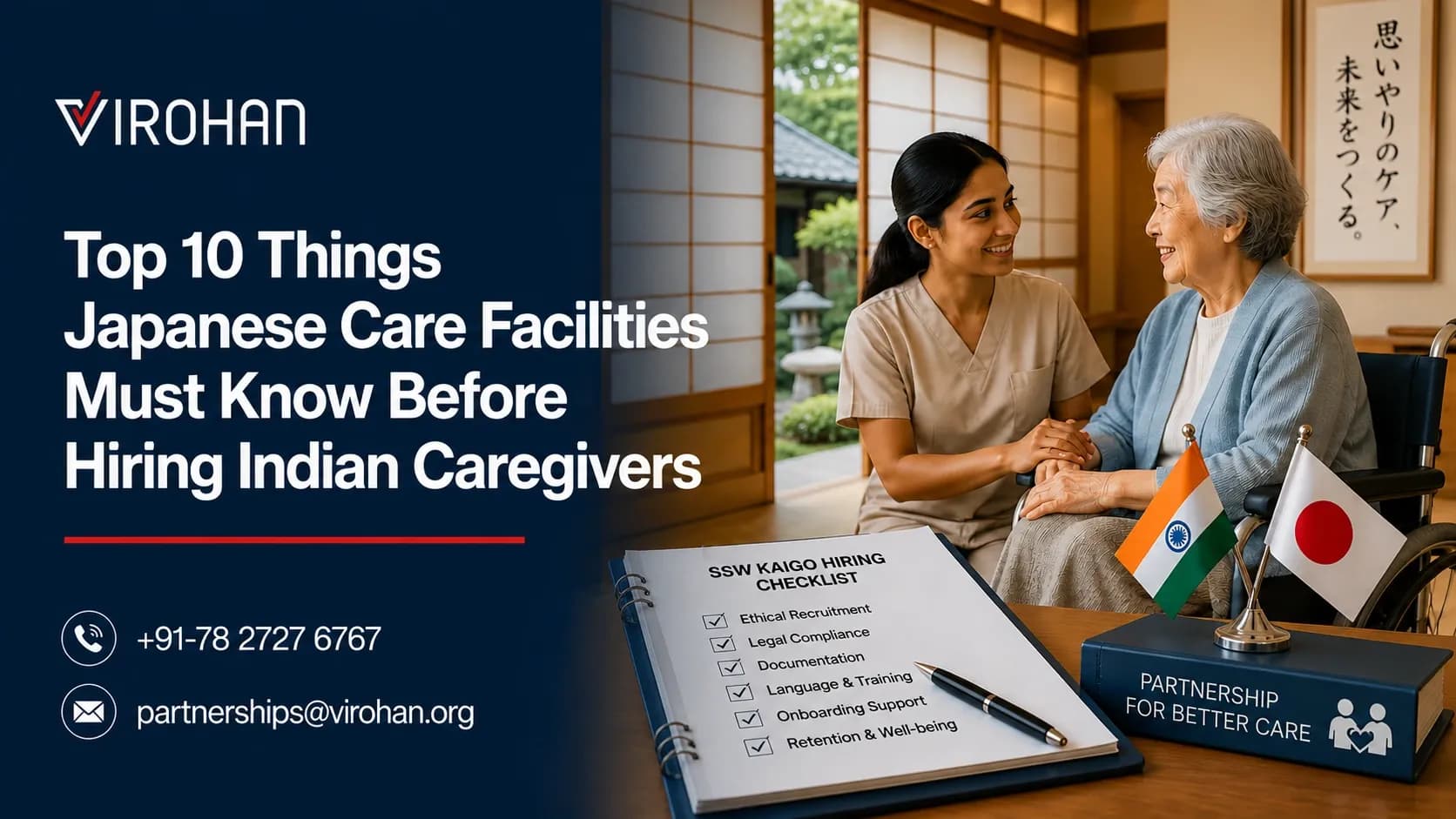
Top 10 Things Japanese Facilities Must Know Before Hiring Indian SSW
Caregivers
Learn the top 10 things Japanese care facilities must know before hiring
Indian caregivers under the SSW Kaigo program, including hiring steps,
language readiness, COE documentation, ethical recruitment, onboarding, and
retention.
Japanese care facilities are facing a growing caregiver shortage as Japan’s
aging population continues to increase demand for elderly care. To address
this challenge, many employers are exploring overseas hiring through the SSW
Kaigo program.
Among the available sourcing markets, India is emerging as a strong option.
With a large healthcare talent pool, growing interest in Japan, and strong
caregiving potential, candidates from India can become a reliable long-term
workforce solution for Japanese care homes.
However, hiring international caregivers is not just about filling vacancies.
It requires careful planning, compliance, documentation, language readiness,
and a strong retention strategy. Before starting the hiring journey, Japanese
care facilities should understand the key steps involved.
-
Understand the SSW Kaigo hiring framework first
Before beginning the recruitment process, care facilities should clearly
understand how the SSW Kaigo program works. The Specified Skilled Worker
framework is designed to bring qualified foreign workers into sectors
facing labor shortages, including elderly care.
Employers should first define the role, staffing need, working conditions,
and internal approval process. A structured plan makes the hiring journey
smoother and helps avoid delays later.
For Japanese care facilities, this is not just about hiring one worker. It
is about building a stable model for long-term caregiver hiring.
-
Choose the right recruitment partner in India
A successful international hiring process depends heavily on the
recruitment partner. Japanese employers should work with a trusted partner
who understands both the Japanese care environment and the Indian
healthcare talent market.
The right partner should support candidate sourcing, screening, interview
coordination, language readiness checks, documentation support, visa
coordination, and post-deployment follow-up.
Virohan is building its recruitment and training capabilities to support
Japanese care facilities by helping them access a reliable pipeline of
trained and motivated candidates. With the right partner, the hiring
process becomes more efficient, compliant, and predictable.
-
Prioritize Japanese language readiness early
Language readiness is one of the most important factors in SSW Kaigo
hiring. Japanese care facilities should clearly define the level of
language ability they expect before hiring begins.
Candidates may need to prepare for exams such as:
JFT-Basic or JLPT N5–N3
Many employers prefer candidates who are already language-ready and can
communicate effectively with residents and team members from day one.
Strong Japanese language preparation helps improve workplace
communication, reduce misunderstandings, and support smoother integration
into the care facility.
-
Focus on skill readiness, not just availability
A caregiver should not only be available. They should also be trained,
dependable, and prepared for the realities of elderly care. Facilities
should evaluate more than just basic qualifications. Important qualities
include empathy, communication, discipline, patience, and adaptability.
These matter just as much as technical training.
For candidates from India, proper preparation for Japan’s care environment
is essential. A strong foundation in caregiving basics, workplace
behavior, and cultural readiness improves recruitment success and
retention.
-
Know the COE and visa documentation process
Documentation is one of the most important parts of overseas hiring.
Employers should understand the COE process, visa requirements, and all
supporting paperwork needed for foreign caregiver hiring.
Typical documents may include:
- Passport copies
- Academic and training records
- Language test results
- Employment contracts
- Facility details
- Worker background documents
- Visa-related forms
Incomplete or inconsistent paperwork often causes delays. A reliable
recruitment partner can help coordinate the process and reduce
administrative burden.
-
Follow ethical and compliant recruitment practices
Ethical hiring is essential in international recruitment. Japanese
employers should work only with partners who follow transparent, lawful,
and responsible recruitment practices.
This includes:
- Clear job offers
- No hidden candidate fees
- Fair salary communication
- Proper contracts
- Responsible sourcing
- Honest role expectations
Ethical recruitment builds trust, improves retention, and strengthens the
employer’s reputation. It also helps create a healthier and more
sustainable hiring model for international caregivers.
-
Plan onboarding before the caregiver arrives
Successful hiring does not end with selection. A well-planned onboarding
process is just as important as the recruitment process itself.
Before the caregiver arrives, care facilities should prepare for:
- Shift routines
- Communication norms
- Japanese workplace culture
- Supervisor guidance
- Daily living orientation
When onboarding is planned in advance, caregivers settle in faster and
begin contributing more confidently.
-
Build a retention plan to reduce dropout
Hiring is expensive, and early dropout can be disruptive. That is why
every care facility should have a retention strategy in place from the
beginning.
To improve retention, employers should:
- Assign mentors or buddies
- Support accommodation and adjustment
- Check in regularly
- Address problems early
A strong retention plan helps turn an international hire into a long-term
workforce asset.
-
Understand the role of RSOs and support organizations
Many employers benefit from working with a Registered Support Organization
(RSO). These organizations help foreign workers settle, adapt, and remain
compliant with local requirements.
An RSO can support:
- Daily life orientation
- Paperwork guidance
- Language support
- Workplace adjustment
- Compliance support
- Ongoing worker coordination
For care facilities hiring under the SSW Kaigo program, an RSO can play an
important role in making the transition smoother for both the employer and
the worker.
-
Compare sourcing markets strategically
Japanese employers often compare sourcing countries such as India,
Vietnam, and Indonesia. The best market depends on language readiness,
skill quality, recruitment speed, retention potential, and partner
strength.
India is emerging as a strong option because of its large healthcare
workforce, growing training ecosystem, and increasing interest in Japan as
a career destination.
For facilities looking for a scalable caregiver hiring solution, India can
be an effective market when supported by the right recruitment and
training structure.
Final Thoughts
Hiring caregivers from India under the SSW Kaigo program can be a highly
effective solution for Japanese care facilities facing staffing shortages. But
success depends on more than just finding candidates. Employers should
understand the hiring process, prepare for documentation, support language
readiness, follow ethical recruitment practices, and plan for onboarding and
retention.
Virohan is developing its recruitment and training capabilities with the goal of helping Japanese employers build a dependable pipeline for SSW Kaigo
hiring, with a focus on compliant sourcing, language-ready candidates, smooth
documentation, and long-term retention support.
Before you hire, check these 5 things:
- Language readiness
- Skill readiness
- Documentation support
- Ethical recruitment compliance
- Onboarding and retention plan
Stay Updated on Virohan’s Launch
If your care facility is planning to hire caregivers from India under the SSW
Kaigo program, Virohan can support you with structured and compliant
recruitment.
Visit: www.virohan.com
Email: partnerships@virohan.org
Contact us at: +91 78272 76767
Disclaimer: Virohan is currently in the process of obtaining the Recruiting
Agent licence under the Emigration Act, 1983. This blog is intended for
informational purposes only and does not constitute an offer of services.