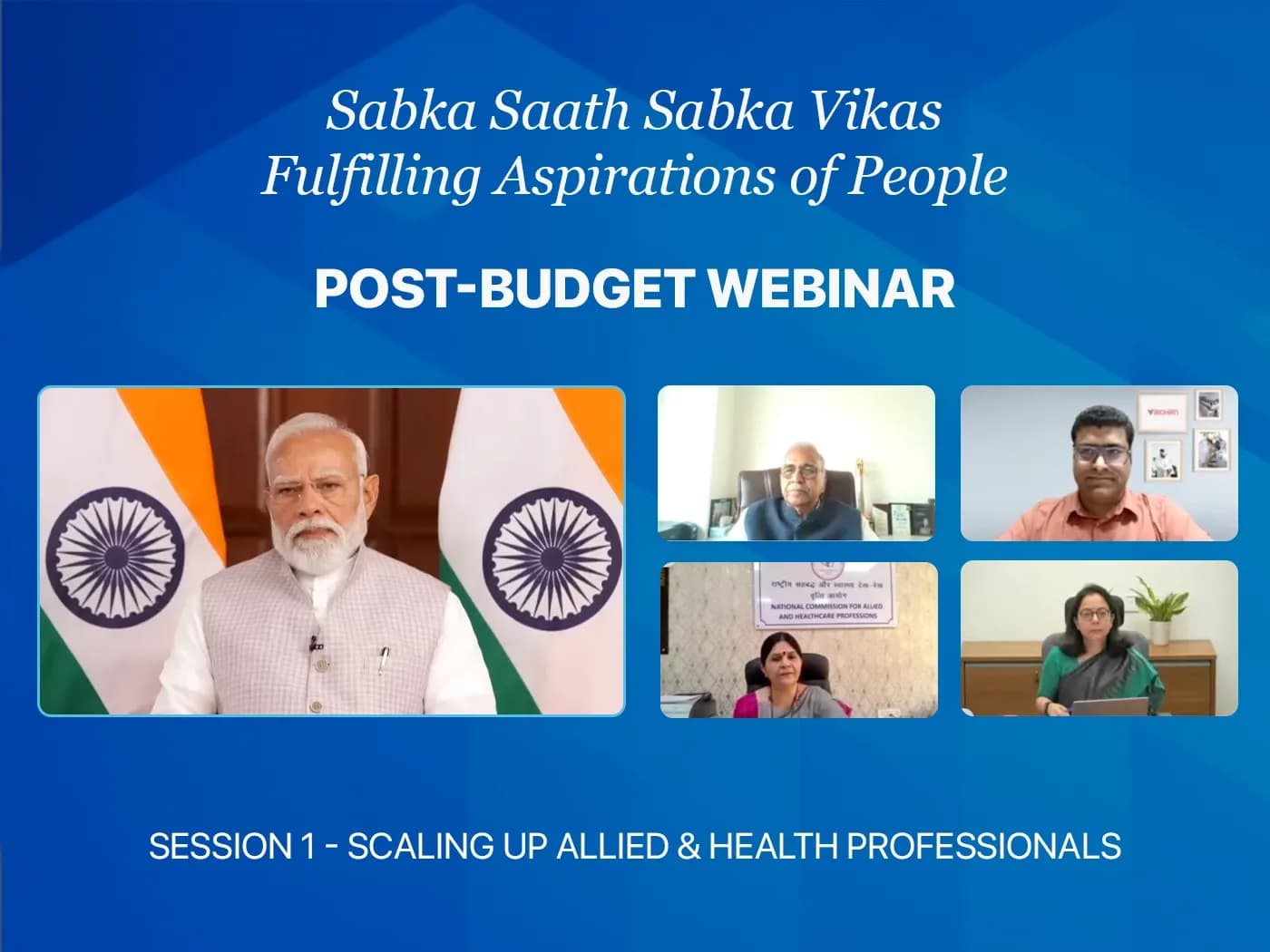
Virohan Joins a National Dialogue on Allied & Healthcare Education
Over the past few months, Virohan has been engaging with the Ministry of Health & Family Welfare on strengthening allied and healthcare education in India. As part of this ongoing dialogue, Dr. Anurag Shahi, Head of Academics at Virohan, was invited to share insights at the Post-Budget Webinar 2026–27, held on 9th March 2026.
The webinar, themed “Sabka Saath, Sabka Vikas – Fulfilling Aspirations of People,” was part of a national consultation addressed by Hon’ble Prime Minister of India, Shri Narendra Modi, focused on translating key budget priorities into actionable reforms aligned with the vision of Viksit Bharat 2047.
Dr. Shahi participated in the session on “Scaling Up Allied & Healthcare Professionals in India,” which brought together policymakers, regulators, healthcare leaders, and academic institutions to discuss strategies for strengthening the country’s healthcare workforce.
The discussion comes at a pivotal moment, following the government’s announcement to add 1,00,000 Allied & Healthcare Professionals over the next five years, alongside plans to upgrade existing institutions and expand training capacity across the country.
Virohan Shares Ground Insights with the Government
During the consultation, Dr.Shahi highlighted key implementation considerations that will determine the success of India’s allied and healthcare expansion.
He noted that while policy momentum is strong, education providers require clear and practical implementation pathways to scale training effectively.
Drawing from Virohan’s experience in healthcare skilling, he emphasised three critical pillars for strengthening allied and healthcare education:
-
Training Infrastructure
Institutions require scalable and accessible infrastructure for advanced labs, simulation and practical training, particularly in tier 2 and 3 cities.
-
Faculty Ecosystem
Faculty frameworks should enable higher education institutions to bring experienced practitioners into academia through models such as Professors of Practice, helping bridge classroom learning with clinical realities.
-
Clinical Exposure
Structured partnerships with healthcare providers are essential to ensure students gain confidence, empathy and hands-on clinical experience.
Dr. Shahi also highlighted that many higher education institutions are ready to expand allied and healthcare programmes but require greater clarity on regulatory processes and transition timelines as the new competency-based curricula under the National Commission for Allied and Healthcare Professions (NCAHP) are implemented.
He suggested that phased implementation and transitional guidance could help ensure existing training capacity is fully utilised while the regulatory ecosystem evolves.
Looking Ahead
The coming years will be a defining period for allied and healthcare education in India.
With growing national demand and increasing policy focus, higher education institutions, healthcare industry, and government must work together to build the skilled healthcare workforce India needs.
Virohan is grateful for the opportunity to contribute to this important national dialogue and to represent the perspectives of the healthcare education ecosystem we are building together.