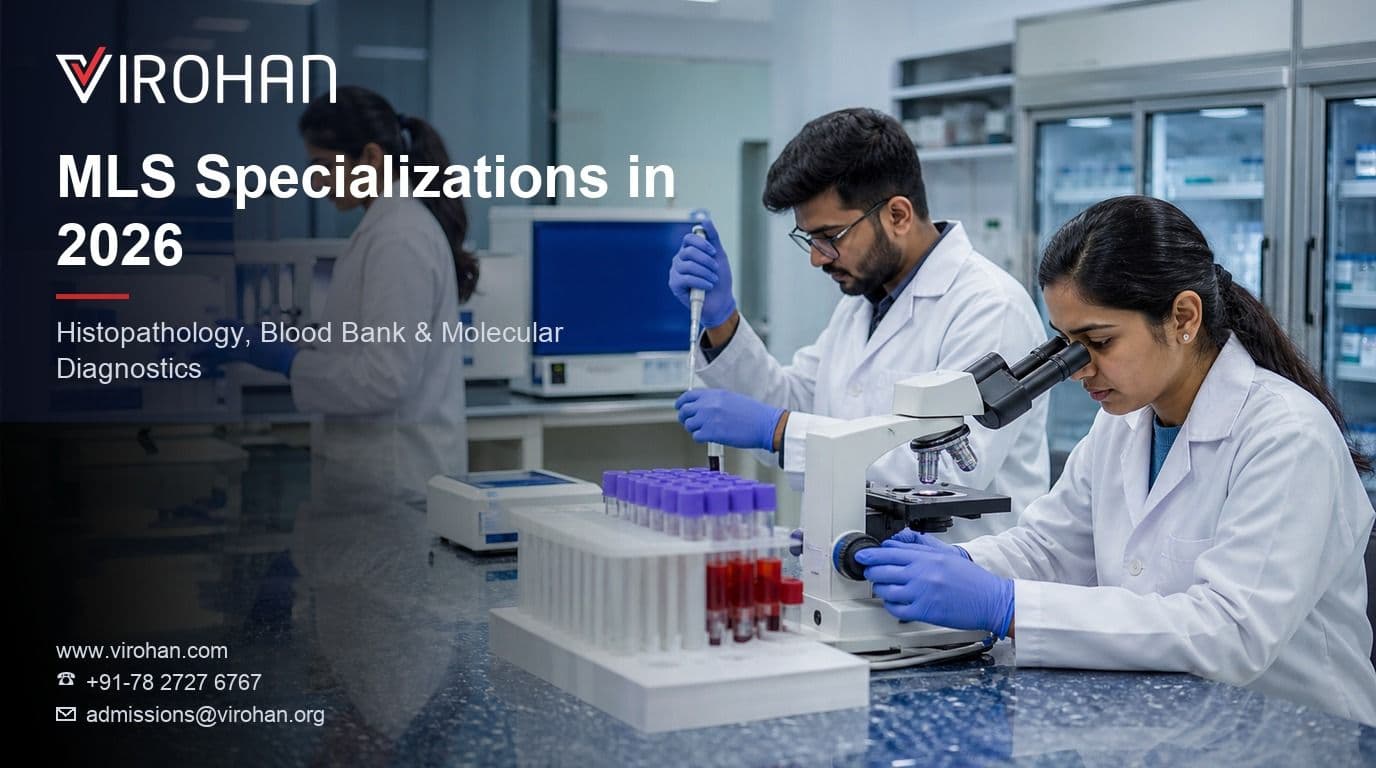
Medical Laboratory Science (B.MLS) is a healthcare degree that trains students in the diagnostic testing methods used in clinical laboratories. For students who want to work in healthcare through laboratory science, B.MLS is a structured route into areas such as histopathology, blood bank technology, molecular diagnostics, microbiology, biochemistry and clinical pathology.
Three of those areas are covered in depth below: histopathology, blood bank technology and molecular diagnostics. One point is worth being clear about from the start. B.MLS is a single degree. Every B.MLS student studies all of these areas, and you do not pick one of them at admission or graduate with a specialization in it on your certificate. They become career paths after the degree, when you start working in one of them and build expertise through experience or postgraduate study.
What Is Medical Laboratory Science?
Medical Laboratory Science (B.MLS) trains students to collect, process, test, validate and report clinical samples. MLS professionals work with blood, tissue, body fluids and molecular samples so that healthcare teams can make informed decisions.
The National Commission for Allied and Healthcare Professions (NCAHP) has notified a competency-based Medical Laboratory Science curriculum, amended by Corrigendum-1 dated 20.03.2026. Eligibility for B.MLS at universities partnering with Virohan is 12th pass with 40% in all subjects individually; PCB mandatory. NEET is not required for B.MLS. The full course, fees and eligibility are covered in the guide to the Medical Lab Science (MLS) course.
Across the four-year B.MLS, students study each of these laboratory areas as part of the curriculum and rotate through them during the internship year. Histopathology focuses on tissue processing and microscopic examination support. Blood bank technology focuses on transfusion safety and blood-component handling. Molecular diagnostics focuses on DNA, RNA, PCR, sequencing, and infection or genetic testing workflows.
Histopathology: Core Concepts
Histopathology is the laboratory processing, staining and examination of human tissue samples. When a surgeon removes a tumour or takes a biopsy, the tissue is sent to the histopathology laboratory for analysis. Laboratory professionals working in histopathology prepare these samples so that pathologists can examine cellular changes under a microscope.
The daily work involves precise laboratory tasks, including microtomy, which is the process of cutting tissue into extremely thin slices, and immunohistochemistry, which helps identify specific proteins within cells. It also covers fixation, embedding, staining, quality control, slide handling and digital pathology workflows.
Digital pathology is changing how histopathology teams work. Physical slides can now be scanned into high-resolution images, allowing better storage, remote review and AI-assisted screening. Peer-reviewed work on AI-assisted whole-slide image review shows how digital tools can support diagnostic review workflows when used under professional supervision.
Skills and Techniques in Histopathology
Histopathology work draws on the following practical skills and techniques, which B.MLS students are introduced to during the degree and develop further on the job:
- Tissue processing - fixation, dehydration, clearing, and paraffin embedding
- Microtomy - cutting thin tissue sections using rotary or cryostat microtomes
- Routine and special stains - H\&E, PAS, Masson's trichrome, reticulin, and Ziehl-Neelsen
- Immunohistochemistry - antigen retrieval, antibody protocols, control slides, and result documentation
- Frozen section support - rapid intra-operative tissue preparation under supervision
- Digital pathology workflows - slide scanning, image annotation, and AI-assisted pre-screening support
- Quality control - equipment checks, slide archiving, SOP adherence, and documentation
Blood Bank Technology
Blood bank technology is a high-responsibility area of laboratory work. It focuses on safe blood collection, blood grouping, compatibility testing, cross-matching, component preparation, storage and transfusion support.
B.MLS students study the ABO and Rh blood group systems and learn how whole blood is separated into red blood cells, plasma and platelets using centrifugation. They also learn donor screening, infection-safety checks, cold-chain procedures and the documentation standards that protect patient safety.
Blood bank technologists manage automated systems that handle high-volume typing and screening while maintaining strict quality-control protocols to ensure transfusion safety. This makes blood bank work a strong fit for people who are detail-oriented, comfortable with protocols and interested in patient-safety systems.
What Blood Bank Work Covers
Blood bank work centers on transfusion safety and component science:
- Donor screening and phlebotomy - eligibility assessment, vein selection, and adverse-reaction management
- ABO and Rh typing - forward and reverse grouping, weak D testing, and antibody screening
- Cross-matching - major and minor crossmatch, indirect antiglobulin tests, and compatibility checks
- Component separation - preparation of red cells, plasma, platelets, and cryoprecipitate
- Apheresis procedures - plateletpheresis and plasmapheresis basics
- NAT and viral marker testing - HIV, HBV, and HCV screening concepts
- Inventory and cold-chain management - expiry tracking, storage temperature, and recordkeeping
Molecular Diagnostics: Techniques and Laboratory Skills
Molecular diagnostics focuses on genetic and molecular testing. Instead of only studying whole cells or routine chemistry values, it uses DNA and RNA testing to help detect infections, classify cancers, identify hereditary conditions and support precision medicine.
The area covers Polymerase Chain Reaction (PCR), quantitative PCR, nucleic acid extraction, contamination control, sequencing basics and result interpretation. These techniques became widely known during COVID-19 testing, but their use extends far beyond viral detection.
Molecular diagnostics suits people who enjoy precision, instrument handling, data interpretation and controlled laboratory workflows. It also requires strong documentation habits, because even small contamination errors can affect results.
Core Molecular Diagnostics Skills
Molecular diagnostics requires precise sample handling and instrument literacy:
- Nucleic acid extraction - DNA and RNA purification from blood, tissue, and swab samples
- PCR and qPCR - thermal cycler operation, Ct value interpretation, and assay controls
- Next-Generation Sequencing - library preparation and basic sequencing workflow awareness
- Sanger sequencing - confirmatory testing basics
- NAT validation - assay verification, limits of detection, and contamination control
- Bioinformatics basics - reading structured result outputs and understanding variant reports
- Biosafety practice - clean-room discipline and separate pre-PCR and post-PCR workflows
How These Areas Work in Practice
Every laboratory area follows a sample-to-report workflow. The pre-analytical phase includes sample receipt, labeling, preparation and suitability checks. The analytical phase is the test itself. The post-analytical phase includes validation, documentation, reporting and communication with the clinical team.
In histopathology, the workflow includes fixation, paraffin embedding, sectioning with a microtome, staining and slide preparation. In blood bank technology, it includes grouping, screening, cross-matching, component preparation, storage and issue documentation. In molecular diagnostics, it includes nucleic acid extraction, amplification, detection, contamination checks and result interpretation.
These workflows are increasingly connected to laboratory information systems and Electronic Health Record systems. MLS professionals must validate machine outputs, maintain data accuracy and follow strict quality-control protocols.
Real-World Examples and Use Cases
This work translates into important clinical support. A B.MLS graduate working in histopathology may assist during frozen-section processing by rapidly preparing tissue sections for pathologist review during surgery. This requires speed, precision and careful coordination with the clinical team.
In a trauma unit, a blood bank technologist may manage urgent blood compatibility testing and component availability. The work requires calm decision-making, strict documentation and a strong understanding of transfusion-safety protocols.
A molecular diagnostics professional might identify BRCA mutations in patient samples, giving oncologists the genetic data needed to decide on an appropriate therapy route for a specific cancer patient. Universities with Virohan as their industry partner help students understand these practical scenarios through program exposure, internships and career guidance connected to healthcare employer needs.
Career Paths After B.MLS
A B.MLS degree opens clinical laboratory careers in hospitals, diagnostic chains, blood banks, reference labs, research-support settings and public health laboratories. Most graduates start in general laboratory roles and move towards one of these areas as they gain experience, or deepen their expertise through postgraduate study such as an MSc in molecular diagnostics or transfusion medicine.
Specialist bench work pays more than general laboratory roles, and pay keeps climbing with experience and responsibility.
| Role | Average annual salary | Top 10% earn above | Top 1% earn above | Source |
|---|
| Histopathology Technician | ₹4 LPA | ₹5.1 LPA | ₹10.3 LPA | AmbitionBox, September 2026 |
| Molecular Biologist | ₹3.9 LPA | ₹5 LPA | ₹12 LPA | AmbitionBox, September 2026 |
| Blood Bank Technician | ₹3 LPA | ₹4.1 LPA | ₹7.8 LPA | AmbitionBox, September 2026 |
| Lab Incharge | ₹5 LPA | ₹6.6 LPA | ₹13 LPA | AmbitionBox, September 2026 |
| Laboratory Manager | ₹8.5 LPA | ₹20.8 LPA | ₹39 LPA | AmbitionBox, September 2026 |
A specialist route is worth aiming for. Histopathology and molecular work pay above general laboratory roles from the day you start, and the senior end of this ladder is reachable: Lab Incharge and Laboratory Manager average ₹5 LPA to ₹8.5 LPA, and the top 10% of laboratory managers earn above ₹20.8 LPA. These figures are indicative rather than guaranteed, and the full role-by-role picture is in the MLS course guide.
The Indian diagnostic laboratories market continues to expand as preventive testing, chronic disease monitoring, hospital networks and advanced diagnostics grow across India. That growth increases demand for trained MLS professionals who can work with automated systems, quality protocols, sample documentation and specialized testing workflows.
Virohan is an industry partner to universities. Through universities partnering with Virohan, students can explore B.MLS pathways while gaining access to 2,000+ healthcare employer partners across 20+ cities for internship and job opportunities. Virohan has worked in allied and healthcare education for nearly a decade, and over 13,000 candidates and alumni are pursuing healthcare education and careers through Virohan's network of top universities and healthcare employer partners.
How to Choose a Career Direction After B.MLS
You do not need to decide on an area before you start the degree. Because every B.MLS student studies histopathology, blood bank technology and molecular diagnostics, and rotates through them during the internship year, most students work out which direction suits them from that hands-on exposure.
Histopathology may suit people who like tissue work, microscopy, structured sample preparation and detailed documentation. Blood bank technology may suit people who are comfortable with protocol-heavy, high-responsibility work where patient safety depends on accuracy. Molecular diagnostics may suit people who enjoy controlled laboratory workflows, genetic testing concepts, instrument handling and data interpretation.
A counsellor conversation can help you judge whether B.MLS fits your academic background, strengths and preferred work environment. Virohan's counsellors help with program and university selection; they do not provide academic tutoring or placement interview preparation.
Where to Study B.MLS: Universities with Virohan as Industry Partner
The universities below offer B.MLS with Virohan as their industry partner:
Eligibility for B.MLS is 12th pass with 40% in all subjects individually; PCB mandatory. NEET is not required. Confirm the latest application criteria, campus availability, fee details and clinical exposure through the Virohan website or a counsellor conversation before applying.
Merit-based scholarships for the B.MLS, such as Virohan's Aspire for Healthcare Scholarship, may be available; amounts, eligibility and availability can change, so check the current terms with Virohan's expert counsellors before you apply.
The Role of NCAHP in Medical Laboratory Science
The NCAHP Act 2021 created a national framework for allied and healthcare professions in India. For Medical Laboratory Science, the notified curriculum gives students, universities and employers a clearer structure for degree nomenclature, competencies, internship expectations and professional standards.
NCAHP has notified competency-based curricula for 17 curricula covering approximately 28 professions, implementable from AY 2026-27 through the NCAHP letter dated 08 April 2026. For B.MLS specifically, students should follow the notified MLS curriculum and current university requirements. DMLT (Diploma in Medical Laboratory Technology) is a separate 2-year NCAHP-notified diploma pathway, distinct from the four-year UG B.MLS. If you want the degree-level route into laboratory science, B.MLS is the pathway to look at. Once qualified, graduates register with the commission; the steps are set out in how to complete NCAHP registration.
Common Misconceptions Clarified
You do not choose a specialization during B.MLS. Histopathology, blood bank technology and molecular diagnostics are subjects every B.MLS student studies, not tracks you select at admission. You do not graduate with a named specialization; you build expertise in an area by working in it after the degree or through postgraduate study.
Histopathology is not a separate short course. Students often search for histopathology training as if it were a standalone course. The structured route into histopathology work is the B.MLS degree, where it is taught as part of the curriculum.
MLS professionals do more than draw blood or run basic tests. Areas such as histopathology and molecular diagnostics require scientific knowledge, instrument handling, quality control and careful documentation.
NEET-UG is not required for B.MLS. Verify current eligibility and application requirements with the university you are considering, because application rules can change by institution.
For a comparison of laboratory course levels and where each leads, see the guide to the best lab technician courses in India.
Quick Reference: Key Terms
- B.MLS: Bachelor of Medical Laboratory Science, the undergraduate degree pathway for Medical Laboratory Science.
- Histopathology: Laboratory study of tissue samples to support disease diagnosis.
- Microtomy: Cutting very thin tissue sections for microscopic examination.
- Immunohistochemistry: A staining method used to identify proteins in tissue samples.
- Crossmatch: A blood bank compatibility test between donor and recipient blood.
- PCR: A molecular technique used to amplify DNA for testing.
- NCAHP: National Commission for Allied and Healthcare Professions, the statutory body for allied and healthcare professions.
Conclusion
Histopathology, blood bank technology and molecular diagnostics are three of the most practical career paths open to B.MLS graduates. Each combines scientific understanding with careful hands-on work, quality control and patient-safety responsibility.
B.MLS gives you a grounding in all three, so you can choose your direction from real laboratory exposure rather than guessing at the start. If you are considering B.MLS, look for a recognized university, clear eligibility criteria, practical internship exposure and a curriculum aligned with current NCAHP expectations. Talk to our expert counsellors if you want help comparing B.MLS programs at universities partnering with Virohan.