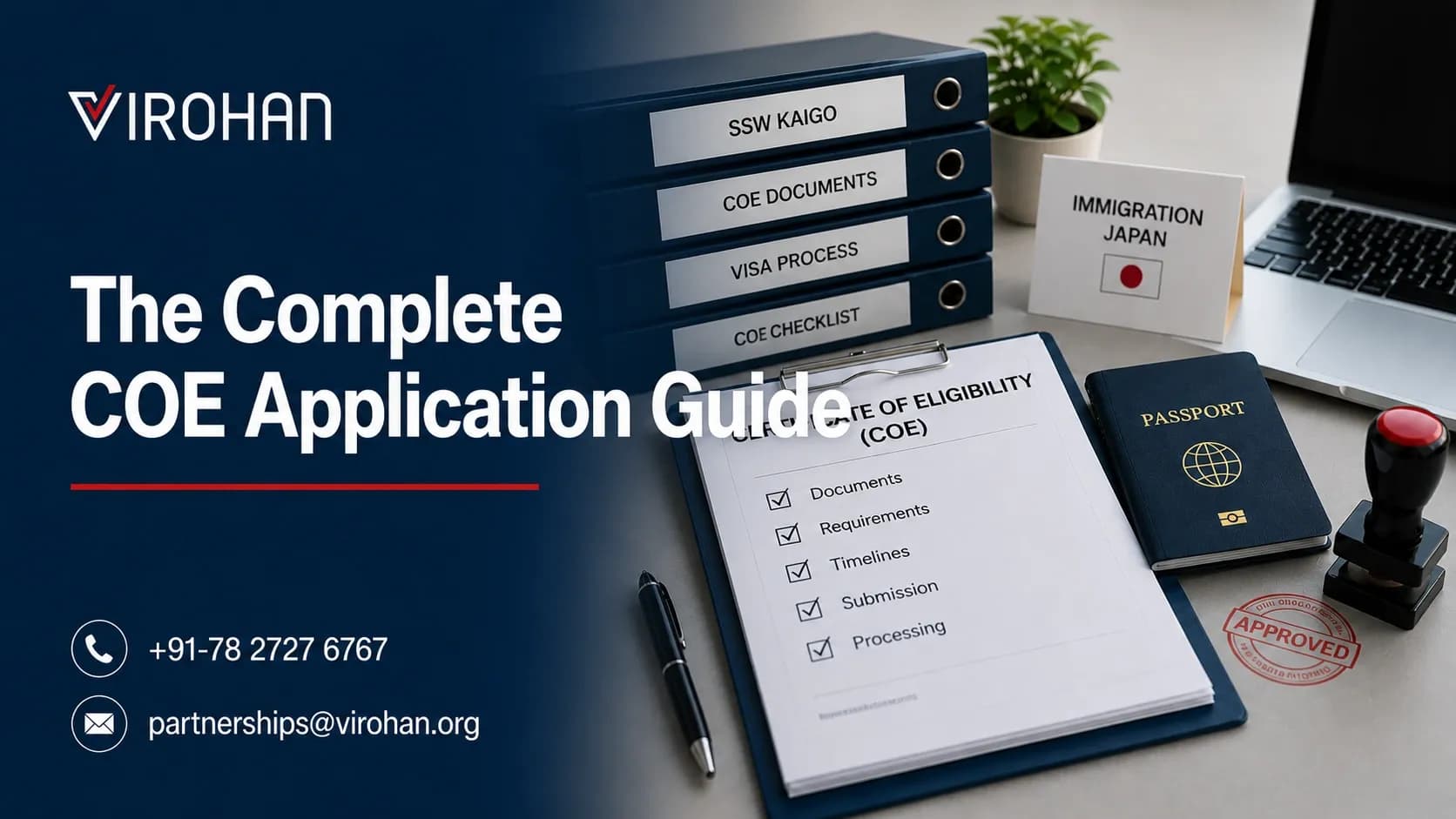
COE Guide for Hiring Indian SSW Kaigo Workers in Japan
A complete COE application guide for Japanese facilities hiring Indian SSW
Kaigo workers. Learn the documents, timelines, and common delay points in the
COE process, plus how Virohan is building its capabilities to support Japan
SSW recruitment from India.
For Japanese care facilities hiring through the SSW Kaigo program, the
Certificate of Eligibility (COE) is one of the most important steps in the
process. It is issued by a regional immigration authority under Japan’s
Immigration Services Agency, and presenting it helps the visa application and
landing examination move more smoothly. A COE does not guarantee a visa, but
it is a key pre-entry document for long-term work in Japan.
For employers planning to hire SSW Kaigo workers from India, understanding the
COE process early can save time, reduce errors, and prevent avoidable delays.
Virohan is building its recruitment capabilities and, once licensed, intends
to support Japanese employers who want a structured and compliant approach to
SSW caregiver (Kaigo) recruitment and overseas healthcare hiring.
-
What the COE is and why it matters
The COE is a preliminary approval issued in Japan before the candidate
applies for a visa at a Japanese embassy or consulate. Official guidance
says that when a COE is presented, visa application and landing
examination are processed more smoothly. It also notes that applying
without a COE can require a large amount of verification documents and may
take several months.
For Japanese care facilities hiring Indian workers under the SSW Kaigo
route, this means the COE is not just a formality. It is a core part of
the hiring process and should be planned alongside candidate sourcing,
language readiness, and document preparation.
-
Who applies for the COE
In practice, a proxy in Japan submits the COE application. Official MOFA
guidance says a proxy can apply for the COE, and the Ministry of Justice
notes that a proxy may include an employee of the receiving organization.
For care facilities, that proxy is usually the accepting organization or
an authorized representative.
This is why Japanese employers hiring under the SSW Kaigo route should
coordinate closely with their internal admin team, support organization,
or recruitment partner. A well-managed proxy process helps keep the COE
application cleaner and faster. Virohan intends to help employers and
partners stay aligned on the documentation flow so the application does
not stall.
-
Documents you should prepare early
The exact document list can vary depending on the case and the bureau but a strong COE
file should clearly show two things: that the candidate meets the SSW
requirements, and that the accepting organization is legitimate and ready
to hire. Official SSW guidance states that SSW nursing care candidates
must pass the nursing care skills evaluation test, a Japanese language
test such as JFT-Basic or JLPT N4 or higher, and the nursing care Japanese
language evaluation test.
For a clean file, Japanese facilities should make sure the package
includes accurate employment details, passport information, and proof of
the required test results, along with the accepting organization’s
documents. If the file is incomplete or inconsistent, the review process
can slow down quickly.
-
Timeline: how long the COE process usually takes
A practical planning window for the COE stage is around two to three
months. Official guidance notes that the COE is designed to smooth the
later visa and landing steps, while visa processing time after application
is generally five working days from the next day after acceptance,
assuming there is no issue with the application. Without a COE, the visa
process can take much longer, typically several months.
For Japanese facilities hiring Indian SSW Kaigo workers, the safest
planning approach is simple: prepare the COE first, allow a 2–3 month COE
window, and then move to visa filing after COE issuance.
-
The most common causes of delays
Most COE delays come from preventable issues. The biggest ones are missing
documents, mismatched details across forms, incomplete employer
information, and weak proof of the required SSW language and skills tests.
For nursing care, the sector-specific language evaluation requirement is
additional, so missing test evidence can immediately slow the file.
Another common problem is weak coordination between the accepting facility
and the proxy in Japan. Since the COE is reviewed by the regional
immigration authority before visa issuance, inconsistent information in
the offer, facility records, or candidate documents can trigger follow-up
checks. Official guidance also makes clear that a COE is a pre-entry
screening document, not a guarantee of visa approval.
For Japanese care facilities hiring foreign workers, the safest way to
avoid delays is to standardize the file before submission. Check names,
passport spellings, job titles, dates, test results, and facility details
line by line.
-
Best practices to keep the COE file clean
Start with a document checklist and use a single source of truth for every
field. Then confirm that the candidate’s SSW eligibility is supported by
the required skills and language evidence. Official guidance is clear that
these tests are central to SSW nursing care eligibility.
It also helps to build buffer time into your hiring plan. Because the COE
stage can take several months and visa timing still depends on consular
processing, employers should avoid promising fixed start dates too early.
That is especially important for care homes that need staffing certainty.
-
How Virohan plans to support the process
Virohan intends to support employers building a practical Japan SSW
recruitment from India strategy. For Japanese facilities hiring caregivers
from India, Virohan’s intended focus is on making the process more
structured by aligning candidate readiness, documentation flow, and
employer expectations. That is especially useful when a facility is
managing SSW caregiver recruitment, Japan caregiver hiring coordination,
and long-term caregiver planning at the same time.
If your team is preparing for COE application, Virohan aims to help keep
the hiring pipeline organized and compliant. Our focus is to reduce
friction and support a more reliable India-to-Japan caregiver recruitment
model.
Final thoughts
The COE is one of the most important parts of hiring Indian SSW Kaigo workers
for Japanese care facilities. When the file is complete, the process is
smoother. When documents are incomplete or inconsistent, delays can stretch
the timeline significantly. Official guidance also makes clear that the COE
helps the visa and landing process move more smoothly, while SSW nursing care
candidates must meet the required skills and language standards.
For employers looking to build a dependable caregiver pipeline, the most
practical approach is simple: prepare the documents early, align on the proxy
process, verify SSW eligibility, and allow enough time for COE and visa
processing. That is the best way to support SSW Kaigo hiring for Japan and
long-term healthcare hiring success.
Stay Updated on Virohan’s Launch
If your facility is planning SSW Kaigo hiring in Japan and needs support for
recruitment from India, connect with Virohan.
Visit: www.virohan.com
Email: partnerships@virohan.org
Contact us at: +91 78272 76767
Virohan aims to support Japanese employers with structured caregiver
recruitment, documentation readiness, and long-term overseas hiring support.
Important Notice: Virohan is currently in the process of obtaining the
requisite Recruiting Agent licence under the Emigration Act, 1983. This blog
is intended for informational purposes only and does not constitute an offer
of services.