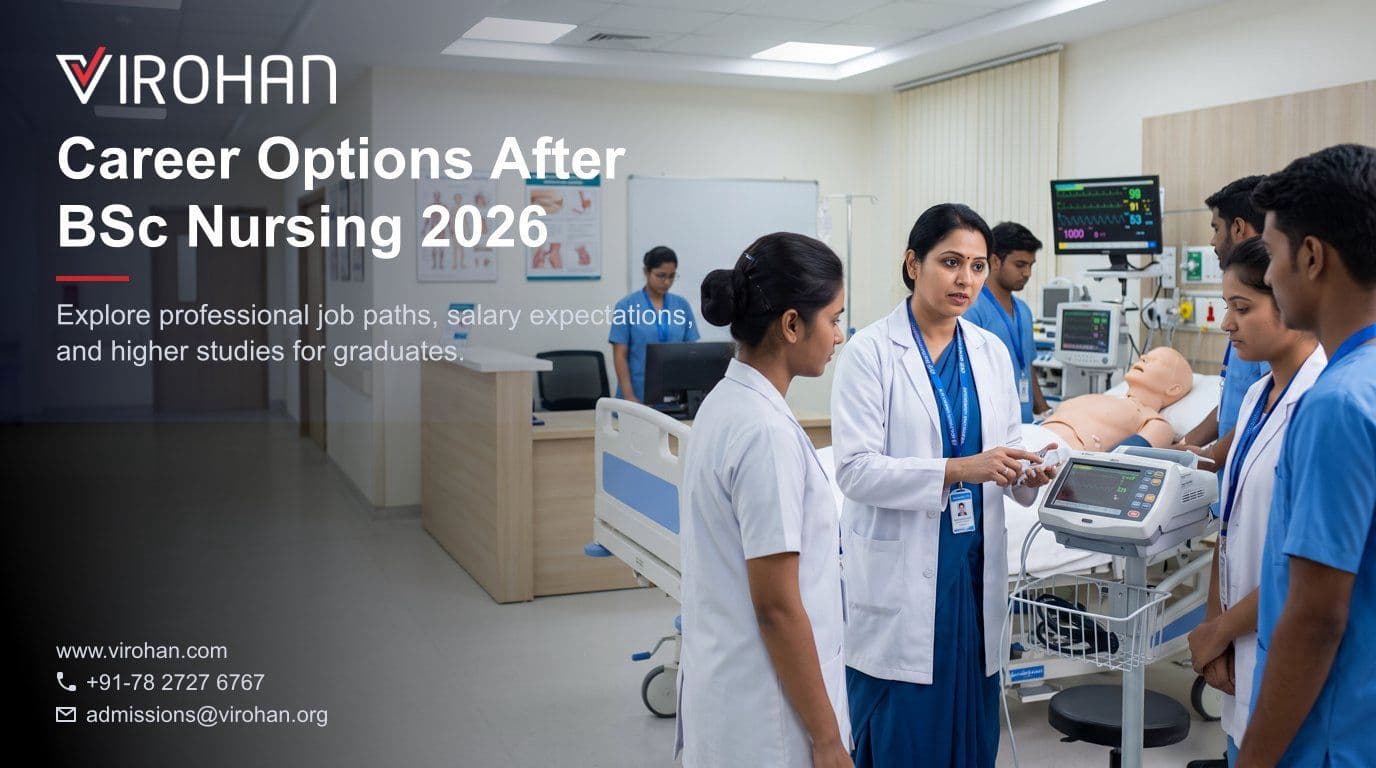
After BSc Nursing, you can begin clinical work as a registered nurse after completing the applicable registration process, specialize in areas such as critical care or operation theatre nursing, move into community and public health, or progress into teaching, administration and research. You can also pursue higher studies in nursing, public health or healthcare management, or prepare for the licensing process required to work abroad.
Here are the main career options after BSc Nursing, common work settings, government routes, indicative salary information and higher-study pathways in 2026.
Your degree gives you a foundation in patient care, nursing procedures, communication, clinical decision-making and care coordination. Your next step can therefore be based on the work you want to perform, the setting you prefer and whether you want to continue studying.
Nursing Regulation in India: INC and State Nursing Councils
The Indian Nursing Council is an autonomous body under the Ministry of Health and Family Welfare. According to the INC, its role includes establishing uniform standards of training for nurses, midwives and health visitors. The Indian Nursing Council (INC) Revised Regulations and Curriculum for the B.Sc. (Nursing) Program, 2020 set out the four-year program you have completed, including its final-semester internship.
After completing BSc Nursing, you generally need registration with the applicable State Nursing Council to practise as a Registered Nurse and Registered Midwife. Registration requirements, document checks and procedures can vary by jurisdiction, so you should verify the current process with the relevant council.
The INC also maintains information related to recognised nursing qualifications, nursing institutions and the Nurses Registration and Tracking System. Checking whether your qualification and institution meet current recognition and registration requirements is an important step before accepting a job.
Jobs After BSc Nursing
Your first job after BSc Nursing may be in a hospital, community program, clinic, school, workplace health service, public health department or research setting. The role you choose can also influence the higher-study route that fits you best.
Staff Nurse
As a Staff Nurse, you may provide direct nursing care, monitor patients, maintain clinical records, coordinate with the wider care team and support patients and families during treatment. This role is available across public and private hospitals, specialty centers and community-based services.
It can also help you build experience before moving into critical care, paediatrics, mental health, infection control, quality or supervisory work.
ICU or Critical Care Nurse
Critical care nursing involves caring for patients who require close observation and specialized support. You may monitor changes in a patient’s condition, follow care plans, coordinate with critical care teams and communicate important updates to families.
Hospitals may look for relevant clinical exposure, practical competence and the ability to work in a high-responsibility environment. A focused postgraduate qualification or certificate may be useful for long-term progression in this area.
Operation Theatre Nurse
An Operation Theatre Nurse supports the surgical team before, during and after procedures. Your responsibilities may include preparing the operating environment, checking equipment and supplies, maintaining sterile practices, supporting patient transfer and documenting nursing care.
This path can suit you if you are interested in structured clinical procedures, teamwork and surgical care settings.
Community Health Nurse
Community Health Nurses work outside the hospital environment in public health programs, community centers, outreach services and other local settings. Your work may include health education, preventive care, follow-up support, maternal and child health services and coordination with community workers.
This route can be meaningful if you want your nursing work to include health promotion and ongoing community contact.
School and Occupational Health Nurse
Schools, workplaces and organizations may require nursing support for first aid, health screening, health education, wellness activities and referral coordination. Occupational health roles can also involve supporting workplace health and safety initiatives.
These positions may provide a more structured schedule than some hospital roles, although the responsibilities and working hours depend on the employer.
Infection Control Nurse
An Infection Control Nurse supports practices that reduce the risk of infections in healthcare settings. You may help monitor procedures, support staff education, review compliance and contribute to infection prevention activities.
This role combines clinical knowledge, observation, communication and quality improvement. Additional training in infection prevention can support your development in this field.
Nursing Supervisor
A Nursing Supervisor coordinates nursing teams and helps maintain the quality and continuity of patient care. Depending on the organization, your work may include staff coordination, shift planning, escalation of patient-care concerns, documentation review and communication between nursing teams and hospital departments.
Experience in clinical nursing is generally valuable before moving into a supervisory position. An MSc Nursing or a qualification in healthcare management can support further progression.
Nurse Educator
You can move towards nurse education after gaining clinical experience and pursuing relevant higher studies. A Nurse Educator may teach nursing students, support clinical demonstrations, develop learning material, assess practical skills and contribute to continuing education for working nurses.
An MSc Nursing or another recognised postgraduate route may be important for the eligibility requirements of specific teaching positions. You should check the criteria of each institution before applying.
Research and Quality Roles
Your nursing background can also support work in clinical research, healthcare quality, patient safety and evidence-based practice. These roles may involve data collection, documentation, protocol support, audit activities, quality reporting and coordination with clinical teams.
A postgraduate qualification can expand your access to research, teaching and quality leadership roles.
Government Job Routes After BSc Nursing
A BSc Nursing graduate can explore government recruitment routes through central government institutions, state health departments and public-sector healthcare organizations.
The exact eligibility criteria, registration requirements, examination process, experience rules and application dates depend on the recruiting organization. You should read each official notification carefully.
Government nursing recruitment may involve:
- Staff Nurse or nursing officer positions
- State health department appointments
- Nursing roles in public hospitals and health centers
- ESIC healthcare institutions
- Recruitment processes associated with AIIMS
- Military Nursing Service opportunities
The salary, allowances, probation terms and promotion rules are set out in the relevant recruitment notification, so read the current notification for the post you are applying for.
Salary After BSc Nursing in India
There is no single salary for a BSc Nursing graduate. Your pay can vary according to your role, registration status, employer, city, shift pattern, experience, specialty and additional qualifications.
For example, a new Staff Nurse and an experienced Nursing Supervisor may have different responsibilities and compensation. A Nursing Superintendent or senior nursing leader will typically be evaluated against a different level of experience and organizational responsibility.
Indicative salary by nursing role
The table below shows the average pay and the higher bands for five common nursing roles, from your first staff position to senior leadership.
| Role | Average | Top 10% | Top 1% | Source |
|---|
| Staff Nurse | ₹3 LPA | ₹4.2 LPA | ₹7.8 LPA | AmbitionBox, September 2026 |
| ICU Staff Nurse | ₹3.4 LPA | ₹4.5 LPA | ₹10 LPA | AmbitionBox, September 2026 |
| Nursing Tutor | ₹3.3 LPA | ₹4.5 LPA | ₹10.4 LPA | AmbitionBox, September 2026 |
| Nursing Supervisor | ₹5.8 LPA | ₹8 LPA | ₹15 LPA | AmbitionBox, September 2026 |
| Nursing Superintendent | ₹10.4 LPA | ₹15 LPA | ₹25.5 LPA | AmbitionBox, September 2026 |
These annual figures show how your earnings can grow as you move from bedside roles into teaching, supervisory and leadership positions.
When you compare job offers, review more than the headline salary. Check the following details:
- Whether the amount is monthly gross pay, take-home pay or total compensation
- Night-shift, overtime and other allowances
- Probation and contract terms
- Staff accommodation, transport or other benefits
- The number of shifts and expected working hours
- The clinical department and level of responsibility
- Registration and experience requirements
- The location and cost of living
Treat online salary figures as indicative rather than guaranteed. A salary page may combine data from different cities, experience levels and employers.
Higher Studies After BSc Nursing
Higher studies can help you deepen clinical expertise, move into teaching or administration, enter public health and research, or prepare for leadership roles.
MSc Nursing
An MSc Nursing is a common postgraduate route after BSc Nursing. It can support advanced study in a chosen nursing area and may strengthen your prospects in clinical leadership, nurse education, research and academic roles.
When selecting an MSc pathway, consider whether you want to remain closely involved in patient care, move into teaching, develop research skills or progress towards nursing administration. Check the institution’s current eligibility, registration and specialization requirements before applying.
Post Basic Diploma Courses
Post Basic Diploma courses can provide focused study in a particular nursing area. They may be relevant if you want targeted knowledge while building on your existing nursing qualification.
The availability, duration, recognition and eligibility requirements of these courses vary by institution and specialty. Confirm the current course structure and registration value before enrolling.
Master of Public Health
A Master of Public Health can help you move towards population-level health work. Possible areas include public health programs, health education, community interventions, program coordination, monitoring and evaluation.
This route may suit you if you want to work with communities, health departments, non-government organizations, public health programs or research teams rather than focusing only on bedside care.
Master of Healthcare Administration
A postgraduate qualification in healthcare administration can support a transition into healthcare operations, quality, patient experience, workforce coordination and service management.
You may consider this route if you enjoy planning, coordination, systems improvement and team leadership. Before applying, compare the course curriculum, project or internship structure and eligibility requirements.
PhD in Nursing
A PhD in Nursing is a research-focused route for you if you want to build an academic or research career. It can involve developing a research question, conducting original work, analyzing evidence and contributing to nursing knowledge.
Universities set their own research areas, entrance requirements and selection procedures. Review the current doctoral requirements directly with the institution.
Working Abroad After BSc Nursing
BSc Nursing can be the starting point for an international nursing career, but your Indian qualification does not automatically grant permission to practise in another country. Each country has its own licensing, registration, documentation, language and assessment requirements.
For the United States, the NCLEX-RN is a central part of the nursing licensure process. For the United Kingdom, you need to understand the registration requirements of the Nursing and Midwifery Council, commonly called the NMC.
Before you begin an overseas application, check:
- Whether your nursing education meets the destination regulator’s requirements
- Whether your State Nursing Council registration and documents are current
- Whether credential evaluation is required
- Whether an English-language test is required
- Whether you need to pass a licensing examination
- Whether the country requires a health check, police verification or other documents
- Whether your intended role matches the registration category available to you
Licensing rules can change, so use the current regulator requirements for your chosen country. Be cautious about any agency promising a guaranteed overseas job, salary or visa outcome.
Allied and Healthcare Degrees as Another Healthcare Career Path
If you or someone in your family is still choosing a healthcare degree after Class 12, allied and healthcare degrees are a separate set of undergraduate routes worth exploring on their own merits. They are not postgraduate specializations after BSc Nursing, and each one leads to its own area of clinical or diagnostic work.
These degrees are offered at universities partnering with Virohan as their industry partner:
Eligibility at universities partnering with Virohan (minimum age 17 by the intake cut-off):
- BPT: 12th pass with 40% in all subjects individually; English mandatory; minimum 50% in PCB
- B.Optom: 12th pass with 40% in all subjects individually; minimum 50% in PCB/PCM
- B.MLS: 12th pass with 40% in all subjects individually; PCB mandatory
- B.MRIT: 12th pass with 40% in all subjects individually; PCB mandatory
- B.AOTT: 12th pass with 40% in all subjects individually; PCB/PCM mandatory
NEET is not required for B.Optom, B.MLS, B.MRIT or B.AOTT. For BPT, NEET is not required for AY 2026-27, and the requirement has been deferred to AY 2027-28. Talk to Virohan counsellors to compare these programs and the universities that offer them.
Conclusion
The career options after BSc Nursing include direct clinical practice, critical care, operation theatre work, community health, infection control, supervision, education, research and healthcare administration. Higher studies such as MSc Nursing, Post Basic Diploma courses, MPH, healthcare administration programs and PhD research can help you build a more focused path. Working abroad is also possible, subject to the licensing rules of the country you choose.
If you are separately exploring allied and healthcare degree programs, Virohan is an industry partner to higher-education institutions and has nearly a decade in allied and healthcare education. Its network includes 2,000+ healthcare employer partners across 20+ cities. You can talk to our expert counsellors for guidance on program and university selection.