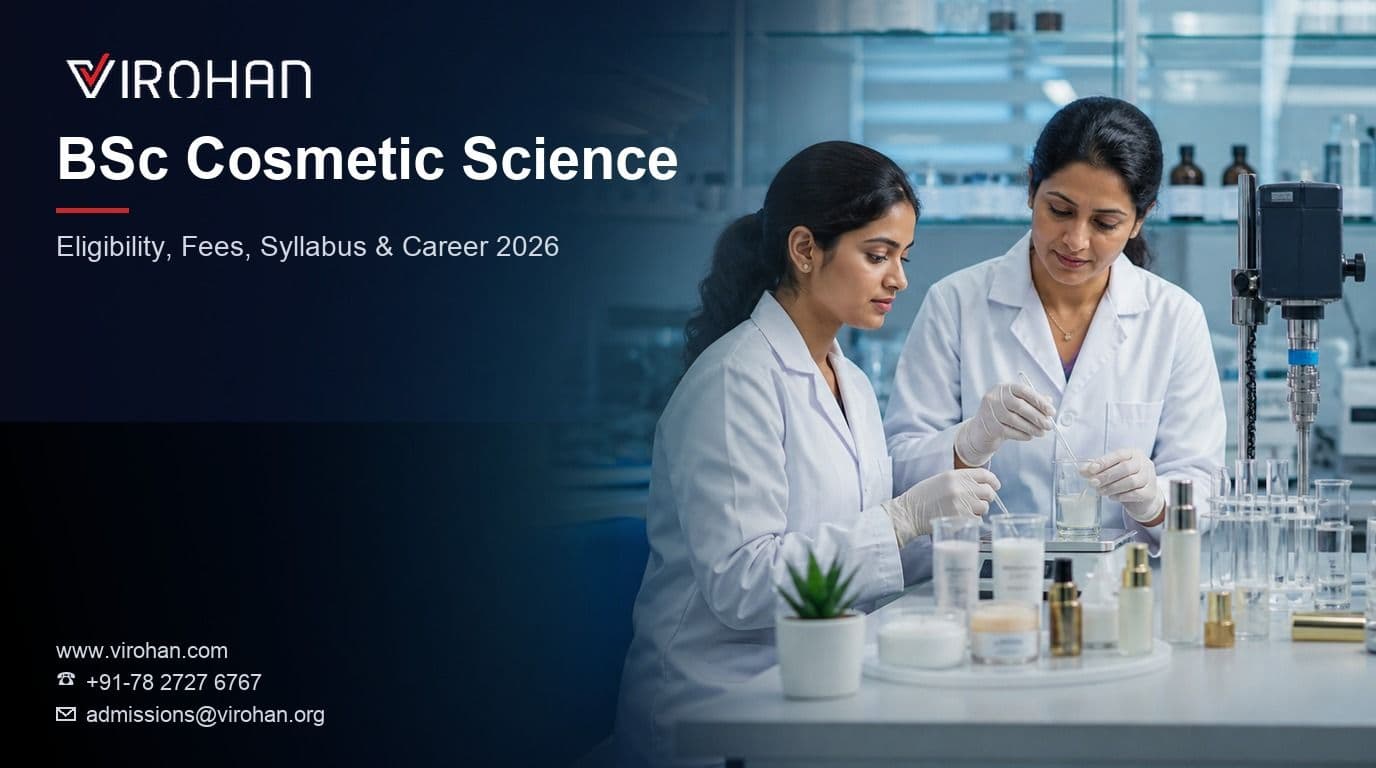
B.Sc. (Hons.) Cosmetic Science is a science-led undergraduate path covering cosmetic formulation, skin and hair applications, aesthetic procedures, and the devices used in modern cosmetic practice. You learn product development and testing alongside dermatology foundations, advanced procedures, devices and light therapy, and practice management. The degree can prepare them for product, clinic, aesthetic, and other healthcare-adjacent workplaces. Verify eligibility, fees, duration, and syllabus with expert counsellors before applying.
If you enjoy chemistry, biology, skin and hair science, and product design, this degree channels those interests into work across cosmetic products and aesthetic services. You can build laboratory and quality skills while learning how advanced procedures, devices, and light-based therapies are used in supervised cosmetic practice. That wider scope matters when you compare syllabi, internship environments, and career options for 2026 and beyond.
Below you will find what the program covers, how eligibility and fees work, how Cosmetic Science fits within healthcare education, where careers typically sit, and which universities currently list the degree with Virohan as industry partner. Confirm every figure and campus detail against current university information.
Detail | Information |
|---|
Course Name | B.Sc. (Hons.) Cosmetic Science (Bachelor of Science, Honours, in Cosmetic Science) |
Course Level | Undergraduate (UG degree) |
Course Duration | 4 years: 2 years classroom study + 2 years internship; confirm the exact structure and exit award with the awarding university |
Application Process | Merit-based; NEET is not required for AY 2026-27 |
Course Eligibility | 12th pass with 40% in all subjects individually across five core subjects; verify the current campus criteria and intake age requirement before applying; NEET is not required for AY 2026-27 |
Course Fees | Total program fees are university-specific. Confirm the current total (not annual) figure with the awarding university or Virohan counsellors and on virohan.com |
Job Profiles | Skin Therapist; Laser Technician; Clinic Coordinator; Patient Counsellor / Patient Care Executive; Front Office Coordinator; Cosmetic Sales; formulation, quality, and product-development roles |
Average Annual Salary | Indicative reference only: an average chemist salary of about ?20,381 per month (roughly ?2.4 LPA) in India, based on 493 reported salaries, updated 22 February 2026 (Indeed, 2026); personal-care roles vary by function, city, employer, and experience |
What Is B.Sc. (Hons.) Cosmetic Science?
B.Sc. (Hons.) Cosmetic Science is an undergraduate science degree built around cosmetic products, skin and hair applications, and aesthetic practice. You study how ingredients behave, how formulas are designed and scaled, how finished products are checked for quality and safety, and how devices and light-based therapies fit into supervised cosmetic settings.
Core learning spans formulation, dermatology, cosmetic ingredients, cell biology, basic biochemistry, cosmetic technology and cosmeceuticals, trichology, and onychology. Four-year honours pathways may also cover advanced procedures, devices and light therapy, clinical cosmetology, and practice management. Product development and quality modules connect lab work with packaging, claims, documentation, batch consistency, and safe use.
The degree is healthcare-adjacent because it combines chemistry, biology, product safety, skin and hair knowledge, and aesthetic applications. Graduates can explore product and laboratory teams as well as derma clinics, aesthetic and laser clinics, cosmetic surgery centres, hair transplant clinics, skin and cosmetology clinics, and multi-speciality hospitals, depending on their skills and the employer's requirements.
Some universities structure Cosmetic Science in more than one format, including honours B.Sc. pathways and, where offered, related vocational routes. Classroom study is paired with internship or industry exposure so you see how pilot batches, stability studies, and production handovers actually work. Exact structure, credit load, and internship design belong to the awarding university, so you should read the current program outline rather than assume one national template.
Choose this path if you want a deliberate, science-first route into skincare and aesthetic care, not a clinical licence. Clarity on that goal helps you compare modules, lab hours, and industry links with a cool head.
Eligibility, Fees and Syllabus: What to Verify
Eligibility, total fees, duration, seat rules, and the full syllabus change by university and academic year. Confirm every item with expert counsellors and the awarding institution before you commit documents or fees. Start by reviewing the latest Cosmetic Science options on the Virohan website, then ask a counsellor to walk you through the details for the universities you are considering.
For Cosmetic Science pathways reflected in that program information, a common baseline is 12th pass with 40% in all subjects individually across five core subjects, with NEET not required. That is a starting point only. A campus may add subject preferences, English rules, or merit processes.
When you review fees, ask for total program fees across the full duration, not a single-year headline. Clarify what is included (tuition, lab charges, exam fees, hostel) and what is extra. Avoid choosing a campus on a vague cost claim. Compare the complete cost against lab access, faculty profile, and internship design.
For syllabus checks, request the latest module list and practical map. Confirm that it clearly shows the product-science and aesthetic-practice components. Useful questions include:
How many contact hours sit in formulation and analytical labs versus theory?
Which topics cover cosmetic chemistry, dermatology, trichology, onychology, packaging, stability, advanced procedures, devices, and light therapy?
How are projects, industrial visits, and internships scheduled across years?
Which assessment methods (practicals, viva, industry projects) count toward the final degree?
Duration and exit awards also need a direct check. Related formats in this subject area can differ in classroom-to-internship balance. Confirm whether you are applying to a B.Sc. (Hons.) track or another approved format at that campus, and what the degree certificate will state.
Talk to our expert counsellors with your mark sheet and preferred cities ready. They can help you compare current university details without guessing from outdated pages.
How Cosmetic Science Fits Within Healthcare Education
Cosmetic Science is a healthcare-adjacent university degree that combines product science, skin and hair applications, and aesthetic practice. It is not an NCAHP-regulated allied and healthcare qualification. The awarding university owns the curriculum, assessment, and final degree.
That distinction still leaves a broad career field. Depending on the syllabus, internship, and employer requirements, graduates can explore aesthetic clinics, cosmetic procedure settings, hospitals, product companies, laboratories, quality teams, and regulatory support. Confirm the exact award name and curriculum for your chosen campus with the university and Virohan counsellors.
Career Scope in Cosmetic Science
Career paths after B.Sc. (Hons.) Cosmetic Science span aesthetic and clinical-adjacent settings as well as product, laboratory, quality, and regulatory teams. Outcomes depend on your skills, internship performance, location, and the employer's hiring cycle, so treat any role or package as earned rather than assured.
Work environments may include:
Derma clinics and skin and cosmetology clinics - supporting skin-care services, client coordination, treatment preparation, documentation, and supervised device-based workflows.
Aesthetic and laser clinics - building familiarity with laser systems, light-based therapies, safety protocols, and patient-care coordination under qualified supervision.
Cosmetic surgery centres and hair transplant clinics - supporting clinic operations, pre- and post-procedure coordination, counselling, and front-office workflows.
Multi-speciality hospitals - exploring skin, hair, wellness, patient-care, clinic-coordination, and related service roles where the employer accepts the qualification.
Cosmetic product companies and testing laboratories - working across formulation, product development, quality control, quality assurance, regulatory documentation, application support, and production interfaces.
Possible early roles include Skin Therapist, Laser Technician, Clinic Coordinator, Patient Counsellor or Patient Care Executive, Front Office Coordinator, Cosmetic Sales, and junior formulation or quality roles. The exact title and scope depend on the employer, local requirements, your practical training, and the devices or procedures you are qualified and authorised to support.
Strong candidates combine careful practical habits with clear communication, scientific writing, client sensitivity, and respect for hygiene and safety protocols. Digital literacy helps with lab records, clinic systems, treatment documentation, and quality trackers.
Use internships to test whether you prefer aesthetic-clinic work, skin and hair services, bench formulation, analytical quality work, or regulatory documentation. Titles and pay bands vary by city, employer, and experience, and none of these outcomes is guaranteed.
Where to Study B.Sc. (Hons.) Cosmetic Science - Universities with Virohan as Industry Partner
You can explore Cosmetic Science at Rungta International Skills University, Vikrant University, and Silver Oak University, with Virohan as the industry partner. Each campus may offer a different degree format, so ask a counsellor to confirm whether the B.Sc. (Hons.) route is available for your target intake and what award name the university uses.
Use precise language when you research these options. The degree is awarded by the university. Virohan acts as industry partner to the higher-education institution. That means industry-aligned support and guidance around program selection and workplace readiness connections, while the university teaches the program and awards the degree.
Practical comparison points when you speak to counsellors about these universities:
Confirm that B.Sc. (Hons.) Cosmetic Science (or the exact approved award name) is open for your target academic year on that campus.
Request total fees, duration, internship structure, and lab facilities in writing.
Ask how industry exposure is scheduled and which cities or employer types have hosted students recently (without treating any list as a guarantee).
Verify hostel, scholarship, and document requirements early so applications are not delayed.
Not every university working with Virohan offers Cosmetic Science, and the degree format can vary across the universities that do. Confirm the exact course title and award format with your chosen university before applying.
Applications guidance for these pathways runs through counsellor conversations rather than cold outreach to scattered portals. Bring your academic stream details, city preferences, and timeline so the discussion stays concrete.
How Virohan Supports Program Selection
Virohan is an industry partner to higher-education institutions, not a university and not a placement agency. For aspirants, the practical value is clearer choices: which science or healthcare-adjacent program fits your strengths, which university currently offers it, and how industry expectations show up in training design. Program pages and counsellor guidance on the Virohan website are the starting point for comparing those options.
With nearly a decade in allied and healthcare education, Virohan works at the junction of students, universities, and employers. Counsellors focus on program and university selection. Universities retain academic ownership, teach the program, and grant the final qualification.
When you explore Cosmetic Science beside regulated clinical options, that separation of roles keeps your decision clear. You can review allied and healthcare courses such as BPT, B.Optom, B.MLS, B.AOTT, or B.MRIT, and still evaluate Cosmetic Science as a distinct, healthcare-adjacent science route where it is offered. Several degrees can suit overlapping interests, and a counsellor conversation is the right place to sort through them.
Virohan supports students by giving them access to 2,000+ healthcare employer partners across 20+ cities for internship and job opportunities, where a program's design connects to that ecosystem. Cosmetic Science employers may include derma, aesthetic and laser, skin and cosmetology, cosmetic surgery, hair transplant, and multi-speciality hospital settings, along with personal-care product, testing, quality, and regulatory organisations. That access is not a placement guarantee.
Talk to our expert counsellors with your marks, subject combination, budget range for total fees, and preferred states. Ask them to compare the current details for Rungta International Skills University, Vikrant University, and Silver Oak University, walk through eligibility line by line, and flag any detail that still needs campus confirmation.
Conclusion
B.Sc. (Hons.) Cosmetic Science is a deliberate, science-led undergraduate path if you want to build a career across aesthetic practice, skin and hair applications, cosmetic procedures and devices, formulation, quality, and product development. Its healthcare-adjacent focus helps you compare modules, practical training, workplaces, and internships on substance.
For study options tied to industry partner Virohan, compare Rungta International Skills University, Vikrant University, and Silver Oak University, then verify live eligibility, total fees, duration, exact award format, and syllabus before you apply. Over 13,000 candidates and alumni are pursuing healthcare education and careers through Virohan's network of top universities and healthcare employer partners, which reflects ecosystem scale rather than a guaranteed outcome for any single program.
If Cosmetic Science matches how you like to work in the lab and on product problems, take the next step with a counsellor review of current university details. Talk to our expert counsellors, confirm every number on paper, and choose the campus pathway that fits your goals for 2026.
Salary figures and fee estimates are indicative and may vary based on institution, location, and individual performance. Verify current details directly with Virohan counsellors or your chosen institution.