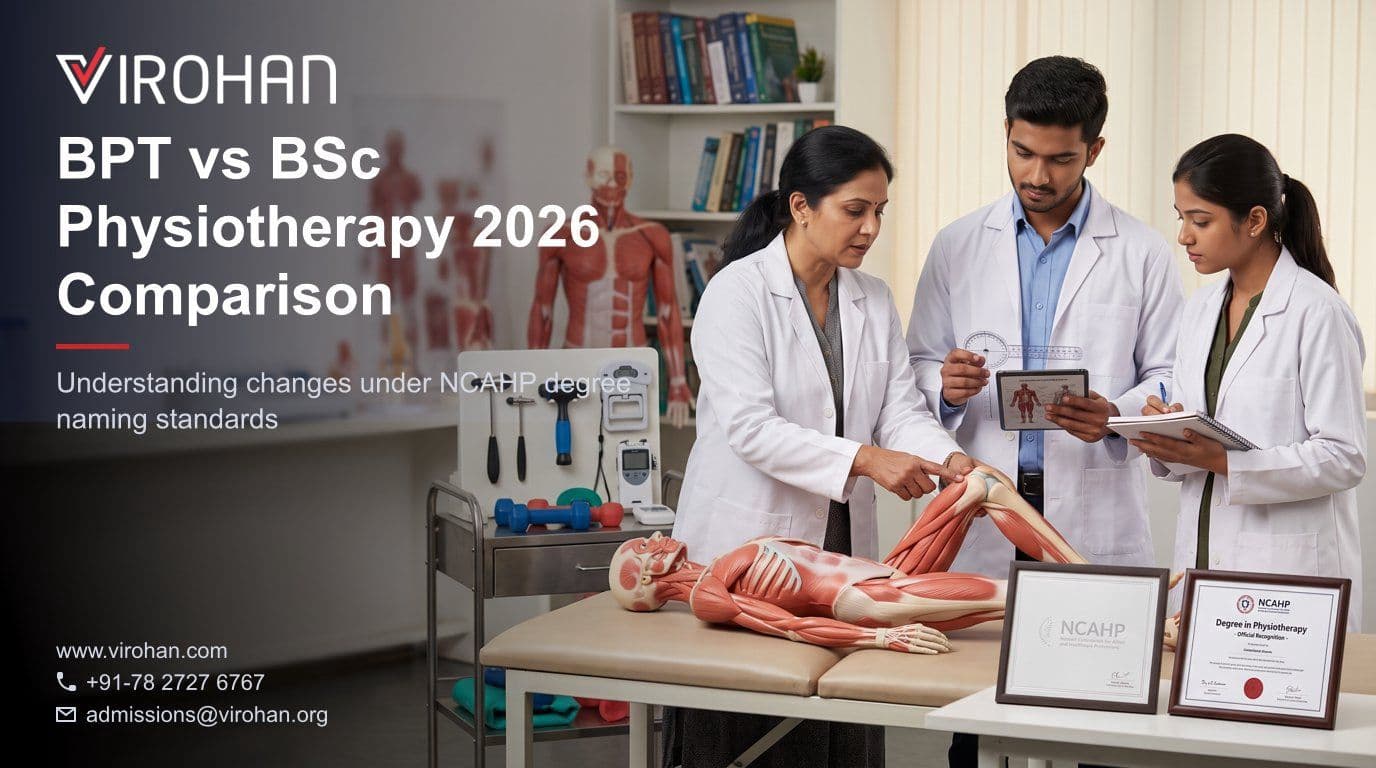
If you are searching for the difference between BPT and BSc Physiotherapy, the key 2026 update is the degree name. Under the National Commission for Allied and Healthcare Professions (NCAHP) framework, the canonical undergraduate degree name is Bachelor of Physiotherapy (BPT). It is a 5-year degree with 4 academic years followed by a 1-year clinical internship.
“BSc Physiotherapy” is still a common search term and may appear in older or differently worded course listings. However, you should check the exact degree name, curriculum alignment, duration and university awarding the degree before submitting an application.
| Course detail | BPT information |
|---|
| Course Name | Bachelor of Physiotherapy (BPT), the canonical NCAHP degree name. “BSc Physiotherapy” is a common search term for the field. |
| Course Level | Undergraduate degree |
| Course Duration | 5 years: 4 academic years plus 1 year of clinical internship |
| Admission Process | Apply to the university. NEET is not required for AY 2026-27; the requirement has been deferred to AY 2027-28. |
| Course Eligibility | 12th pass with 40% in all subjects individually; English mandatory; minimum 50% in PCB. Minimum age: 17 years. |
| Course Fees | Total program fee varies by university. Confirm the current 5-year fee on the Physiotherapy (BPT) course page. |
| Job Profiles | Physiotherapy Consultant, Rehabilitation Specialist, Orthopedic Physiotherapy, Corporate Wellness Physiotherapy and Ergonomics Specialist |
| Average Annual Salary | Indicative: Physiotherapist, ₹3.4 LPA average; Senior Physiotherapist, ₹4.9 LPA average. See the AmbitionBox salary data, September 2026. |
BPT vs BSc Physiotherapy: What the 2026 naming change means
The practical answer is that BPT is the standard degree name you should look for when applying for an undergraduate physiotherapy program in 2026.
NCAHP has standardized degree nomenclature, eligibility criteria, duration and curriculum expectations for allied and healthcare courses. Its Degree Nomenclature and Admission Eligibility letter dated 08 April 2026 states that approved curricula, degree nomenclature and admission eligibility criteria are to be adopted for the relevant courses for AY 2026-27. NCAHP’s important letters page also lists the earlier 09 January 2026 nomenclature and eligibility communication.
This does not mean that every course using the words “BSc Physiotherapy” is automatically invalid or that every BPT listing is automatically aligned. The degree title by itself is not enough to establish a course’s status. You should review:
- Whether the degree is named Bachelor of Physiotherapy (BPT).
- Whether the program follows the NCAHP physiotherapy curriculum.
- Whether the duration is 5 years, including the clinical internship.
- Which university awards the degree.
- Whether the eligibility criteria and NEET position match the current requirements.
A practical comparison
| Point of comparison | BPT | BSc Physiotherapy |
|---|
| Canonical 2026 degree name | Bachelor of Physiotherapy (BPT) | Common search or legacy wording |
| NCAHP nomenclature | Matches the current canonical name | Verify whether the listing has been updated to the NCAHP nomenclature |
| Duration to check | 5 years, including 1-year internship | Do not assume the duration. Confirm the official program structure |
| Curriculum to check | NCAHP Physiotherapy curriculum | Confirm whether the course is aligned with the NCAHP curriculum |
| Best application approach | Compare university, curriculum, internship and fee details | Confirm whether the course is actually offered as the NCAHP-aligned BPT degree |
So, when you compare BPT and BSc Physiotherapy, focus less on the letters “BSc” and more on the official degree title, curriculum, duration, university and clinical training structure.
NCAHP framework for BPT in 2026
NCAHP’s physiotherapy framework matters because it gives universities a common reference for the degree name, curriculum, eligibility and clinical learning requirements.
The NCAHP curriculum page lists the Physiotherapy curriculum notified on 24 April 2025. It also lists Corrigendum-1 dated 27 January 2026 and subsequent updates. The curriculum is part of NCAHP’s broader implementation of competency-based curricula for allied and healthcare professions from AY 2026-27.
NCAHP’s 08 April 2026 communication also refers to requirements such as:
- Adoption of the approved curriculum and degree nomenclature.
- Alignment of eligibility criteria with the approved course requirements.
- Suitable infrastructure and learning facilities.
- Access to a clinical practising facility or an appropriate arrangement with one.
- Intake capacity aligned with the approved curriculum.
- Improvement of laboratories and other academic facilities.
These requirements are particularly relevant to BPT because physiotherapy education combines academic study with supervised clinical exposure. When you evaluate a course, the internship should be a defined part of the degree structure rather than an unclear add-on.
The framework is also operating through transition arrangements while final regulations for recognition of institutions are being processed. That is another reason to verify the current program page and awarding university before you apply.
BPT duration and curriculum under NCAHP
BPT is a 5-year undergraduate degree:
- Four academic years of classroom, practical and clinical learning.
- One year of clinical internship.
How the subject flow usually develops
The exact semester arrangement can vary by university, but you can understand the academic progression in four broad stages.
Year 1: Foundational healthcare sciences
You begin with the scientific foundation required for physiotherapy practice. Core areas include:
- Anatomy
- Physiology
- Basic healthcare sciences
- Introduction to movement and the human body
These subjects help you understand body structures, normal functions and the physical basis of movement.
Year 2: Movement science and therapeutic techniques
The next stage moves toward how the body moves and how physiotherapy interventions are planned. Common areas include:
- Biomechanics
- Exercise therapy
- Electrotherapy
- Therapeutic movement
- Assessment principles
You start connecting scientific concepts with practical techniques used in rehabilitation.
Year 3: Musculoskeletal and neurological physiotherapy
You then study conditions that affect movement, strength, coordination and independence. The subject flow includes areas such as:
- Orthopaedic physiotherapy
- Neurological physiotherapy
- Musculoskeletal assessment
- Rehabilitation planning
This stage helps you understand how physiotherapy is used for different conditions and functional limitations.
Year 4: Broader clinical applications
The later academic year expands your exposure to wider clinical areas, including:
- Cardiopulmonary physiotherapy
- Sports physiotherapy
- Advanced rehabilitation
- Clinical decision-making
- Patient communication and professional practice
The aim is to prepare you for supervised clinical work across different patient needs and healthcare settings.
Why the internship is important
The 1-year internship gives you an opportunity to apply academic learning in a clinical environment under supervision. You can develop skills in assessment, treatment planning, therapeutic exercise, rehabilitation communication and patient documentation.
An internship is not a guaranteed job offer. Its value depends on the quality of the clinical setting, the supervision available, the cases you observe and the skills you build during the placement.
BPT eligibility and NEET status for 2026
The eligibility requirement for BPT programs at universities partnering with Virohan is:
12th pass with 40% in all subjects individually; English mandatory; minimum 50% in PCB.
You must also be at least 17 years old, subject to the applicable intake cut-off. Confirm the current cut-off and application details before applying.
Is NEET required for BPT in 2026?
NEET is not required for BPT for AY 2026-27. The requirement has been deferred to AY 2027-28.
This position comes from the NCAHP letter dated 02 March 2026 on the deferral of NEET for B.PT. Since NEET requirements can be tied to a specific academic year, always match the information to your intended intake.
What you should verify before submitting an application
Use the current healthcare and management courses catalogue and the relevant university program page to confirm:
- The exact degree name is Bachelor of Physiotherapy (BPT).
- Your marks meet the subject-wise requirement.
- English is included as a mandatory requirement.
- Your PCB marks meet the minimum 50% requirement.
- You meet the minimum age requirement.
- NEET is not required for your AY 2026-27 application.
- The university awarding the degree is clearly identified.
- The total program fee and internship structure are current.
Career scope and job roles after BPT
BPT prepares you to work in rehabilitation and movement-focused healthcare. The course page describes the field as helping people regain strength, movement and independence, while learning to assess injuries, relieve pain and support recovery through rehabilitation.
Depending on your experience, interests and further study, you can explore roles such as:
- Physiotherapy Consultant: Support assessment and physiotherapy planning for patients in clinical or rehabilitation settings.
- Rehabilitation Specialist: Work with individuals recovering function after injury, illness or physical limitation.
- Orthopedic Physiotherapy: Focus on movement and rehabilitation needs related to bones, joints, muscles and physical injuries.
- Corporate Wellness Physiotherapy: Support movement, posture and workplace wellness initiatives.
- Ergonomics Specialist: Apply knowledge of movement and body mechanics to improve how people interact with work environments.
- Assistive Technology Specialist: Work with assistive approaches and equipment that support mobility and independence.
- Corporate Wellness Physiotherapy: Build programs focused on movement, posture and physical wellbeing in workplace environments.
You may find opportunities in hospitals, rehabilitation centres, clinics, wellness settings, sports organisations and private practice. Your actual role will depend on the employer, location, registration requirements, experience and specialization.
Indicative salary after BPT
Salary figures vary by role, city, employer, experience and performance. AmbitionBox data from September 2026 shows the following indicative figures:
| Role | Average annual salary | Top 10% | Top 1% |
|---|
| Physiotherapist | ₹3.4 LPA | ₹5 LPA | ₹10.9 LPA |
| Senior Physiotherapist | ₹4.9 LPA | ₹7 LPA | ₹12.2 LPA |
These figures are market indicators, not salary guarantees. AmbitionBox also publishes salary information based on employee-reported data, so you should treat the figures as directional when planning your career.
Higher study after BPT
After completing BPT, you can consider a Master of Physiotherapy (MPT). Your postgraduate focus may relate to areas such as:
- Orthopaedic physiotherapy
- Neurological physiotherapy
- Cardiopulmonary physiotherapy
- Sports physiotherapy
- Paediatric physiotherapy
- Rehabilitation-focused practice
The specialization options available to you will depend on the university and its current postgraduate offerings.
Where to Study BPT: Universities with Virohan as Industry Partner
BPT programs are offered at universities partnering with Virohan as their industry partner.
- Vikrant University, Gwalior
- Lingaya's Vidyapeeth, Faridabad
- SR University, Warangal
- MIT University, Shillong
- Invertis University, Bareilly
Program availability, fees and application details can change by university and intake. Review the Physiotherapy (BPT) program details for the current list and contact the counsellors for university selection guidance.
Virohan is an industry partner to higher-education institutions, while the university awards the degree. Virohan supports students by giving them access to 2,000+ healthcare employer partners across 20+ cities for internship and job opportunities. An opportunity to access employers does not represent a guaranteed internship, job or salary.
With nearly a decade in allied and healthcare education, Virohan connects university-based learning with healthcare industry exposure. You can compare the university, course structure, internship details and total program fee before choosing where to apply.
Conclusion
The main difference between BPT and BSc Physiotherapy in 2026 is the degree nomenclature. Bachelor of Physiotherapy (BPT) is the canonical undergraduate physiotherapy degree name under the NCAHP framework. “BSc Physiotherapy” may still appear as a search term or older course wording, but you should verify its curriculum, duration, internship, eligibility and awarding university instead of relying on the title alone.
BPT is a 5-year degree with 4 academic years and a 1-year clinical internship. For AY 2026-27, NEET is not required, while the course eligibility at universities partnering with Virohan is 12th pass with 40% in all subjects individually, English mandatory and a minimum 50% in PCB.
For current university options and application guidance, you can talk to our expert counsellors. With Virohan as an industry partner to higher-education institutions, you can explore BPT programs that combine university-awarded degrees with access to healthcare industry opportunities.