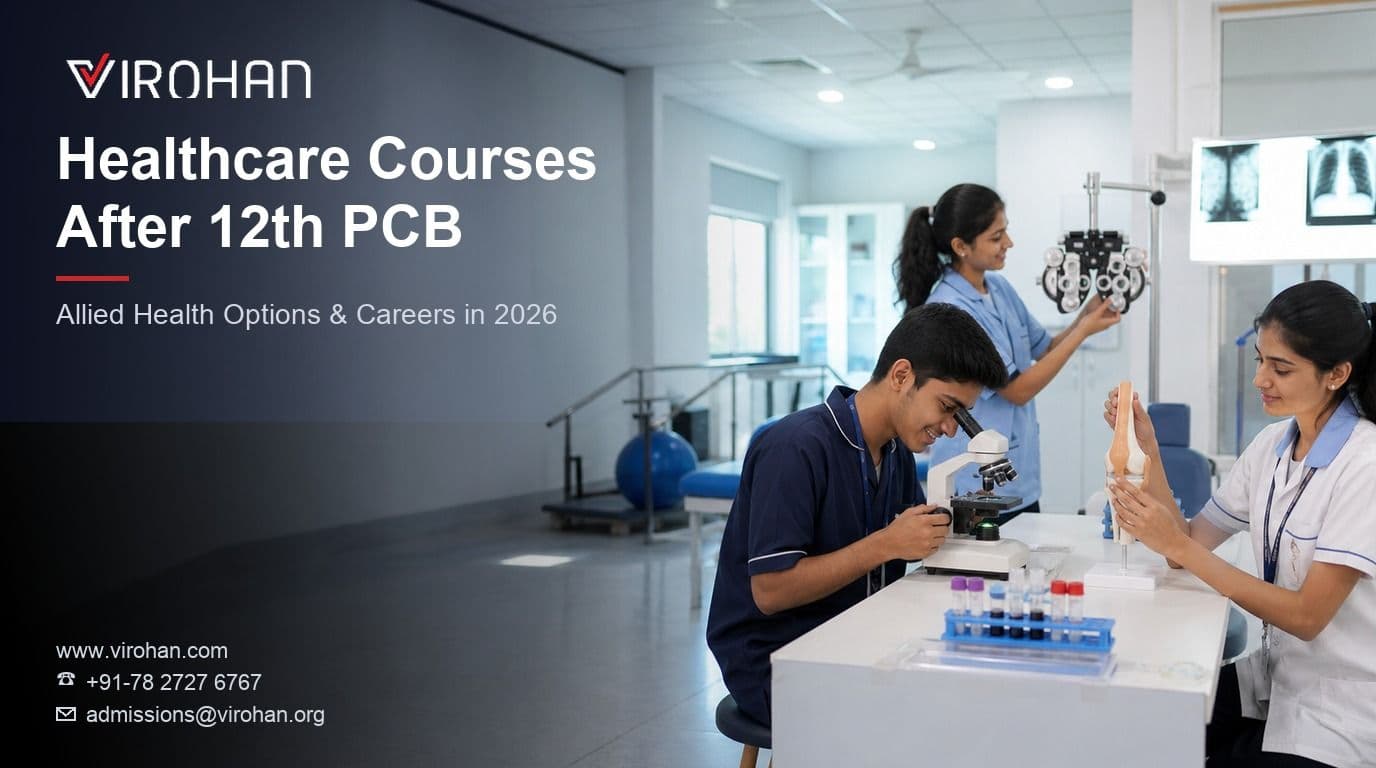
PCB students after class 12 can pursue allied and healthcare undergraduate degrees such as BPT, B.Optom, B.MLS, B.AOTT, and B.MRIT. These pathways lead to clinical and diagnostic careers under India's NCAHP framework. For AY 2026-27, NEET is not required for these programs, including BPT.
If you finished class 12 with Physics, Chemistry, and Biology and want a healthcare career built on patient care, diagnostics, imaging, or theatre work, undergraduate allied and healthcare degrees are a deliberate first choice, not a side path. They sit inside a national professional framework, combine classroom learning with clinical exposure, and open roles across hospitals, clinics, and diagnostic centres. Below are the main degree options PCB students explore in 2026, explains how regulation shapes entry, and shows how to shortlist a program and university with clear next steps, including guidance through Virohan.
NCAHP Framework for PCB Students
The National Commission for Allied and Healthcare Professions (NCAHP) is the statutory body under the Ministry of Health and Family Welfare that sets professional standards for allied and healthcare education in India. For PCB students, that framework matters because it shapes degree names, curriculum direction, and, in some cases, entrance rules for specific professions.
NCAHP has notified competency-based curricula for several professions, including Physiotherapy, Optometry, and Medical Laboratory Science. Other pathways you may still study at university level, such as Medical Radiology and Imaging Technology and Anaesthesia and Operation Theatre Technology, are regulated in principle under the NCAHP Act 2021. As of April 2026, NCAHP has not yet published a notified curriculum for every profession; institutions then follow university-designed curricula while standardisation continues.
Entrance rules also sit inside this framework. An official NCAHP communication on NEET for BPT deferred the NEET requirement for Bachelor of Physiotherapy to academic year 2027-28. For the present cycle, NEET-UG is not required for BPT in AY 2026-27. For B.Optom, B.MLS, B.AOTT, and B.MRIT, NEET is not required either. Always confirm the academic year when you read any NEET statement, because requirements can change with later NCAHP communication.
Why this helps you as a PCB student: a recognised professional structure supports clearer career identity, more consistent training expectations, and better long-term mobility across employers who hire regulated allied and healthcare graduates. When you compare colleges, ask how each university aligns nomenclature, clinical facilities, and internship design with current NCAHP direction for that profession.
Degree Programs to Compare After 12th PCB
Five undergraduate pathways are especially relevant for PCB students who want clinical or diagnostic work after class 12. Programs and degrees belong to the universities that award them. Current eligibility must be checked separately for every program and university, because subject combinations, minimum marks, and English requirements are not identical across degrees.
| Degree | Full name | Typical focus | Typical duration | NEET |
|---|
| BPT | Bachelor of Physiotherapy | Movement, rehabilitation, physical function | 5 years (including internship) | Not required; deferred to AY 2027-28 |
| B.Optom | Bachelor of Optometry | Vision care, refraction, eye health | 5 years (including internship) | Not required |
| B.MLS | Bachelor of Medical Laboratory Science | Laboratory testing and diagnostics | 4 years (including internship) | Not required |
| B.AOTT | Bachelor of Anaesthesia & Operation Theatre Technology | Anaesthesia support and operation theatre practice | 4 years (including internship) | Not required |
| B.MRIT | Bachelor of Medical Radiology and Imaging Technology | Medical imaging and radiology technology | 4 years (including internship) | Not required |
BPT suits students drawn to rehabilitation, exercise science, and hands-on patient recovery plans across orthopaedics, neurology, sports, and community settings. Under current NCAHP direction for AY 2026-27, you can plan BPT entry without treating NEET as a gate for this cycle, while still watching for the deferred requirement from AY 2027-28 onward.
B.Optom centres on primary eye care, refraction, contact lenses, low-vision support, and optical practice in clinics, hospitals, and vision-care networks.
B.MLS builds laboratory competence in sample handling, analytical testing, quality systems, and diagnostic reporting that clinicians rely on every day.
B.AOTT prepares you for anaesthesia assistance and operation theatre workflows, including sterile practice, equipment readiness, and perioperative team coordination.
B.MRIT focuses on imaging modalities and safe imaging practice. Radiation safety culture is central in this field; employers and training sites expect strong protocol discipline alongside technical skill.
Do not force a one-interest, one-degree map. Several degrees can suit students who enjoy patient interaction, detail-oriented work, or technology-heavy clinical environments. Use the table as a shortlist tool, then verify eligibility, fees, clinical exposure, and campus fit for each option you keep.
Learning and Career Environments
Allied and healthcare degrees are practice-facing. Much of your growth happens outside the lecture hall: skills labs, supervised clinical postings, diagnostic floors, outpatient departments, and multidisciplinary teams.
Expect structured clinical learning in hospitals and specialised units matched to your degree. Physiotherapy students spend substantial time in rehabilitation and outpatient settings. Optometry students work with vision assessment and optical workflows. Laboratory science students train in diagnostic laboratories. Anaesthesia and OT technology students learn inside theatre complexes. Radiology and imaging students train around imaging suites and reporting workflows. Diagnostic centres and multi-speciality hospitals are common internship and early-career environments across these pathways.
Technical skill is only part of readiness. Employers also look for essential communication, leadership, digital literacy, and English language skills. You will explain procedures, document findings, hand over cases, use hospital information systems, and work with seniors under time pressure. Building those habits during training makes the shift from student to professional smoother.
Career environments vary by degree, but the pattern is similar: entry roles in clinical or diagnostic teams, then growth through specialisation, seniority, teaching, quality, or supervisory tracks. Internship and placement opportunities depend on the university, the clinical partners attached to the program, and your own performance. Treat every clinical posting as both learning time and professional reputation-building time. As regulation under NCAHP continues to standardise profession names and training expectations, clinical sites increasingly look for graduates who can show both technical competence and professional communication in real care settings.
Choosing a Program and University
Choosing well means matching three things at once: the kind of work you want day to day, the degree that trains for that work, and a university that can deliver clinical exposure with academic seriousness.
Start with the work, not the acronym. Ask whether you prefer continuous patient interaction, laboratory precision, imaging technology, or theatre-based teamwork. Then compare two or three degrees that could fit that preference. Multiple degrees can suit overlapping interests, so rigid self-routing often creates false certainty. A short counsellor conversation usually clarifies which degree fits your strengths, stream marks, location constraints, and long-term goals.
When you evaluate a university, look beyond the brochure title. Check clinical tie-ups, lab and equipment access, faculty support for practicals, internship design, assessment style, and how clearly the campus explains eligibility and total program fees. Confirm the exact eligibility string for the program you want; do not assume BPT rules apply to B.MLS, or that PCB alone is enough everywhere English or mark thresholds differ. For BPT specifically, reconfirm NEET status for the academic year you are targeting, because NCAHP has already signalled a shift toward AY 2027-28 for that profession while AY 2026-27 remains open without NEET.
Applications through universities partnering with Virohan as their industry partner are open year-round across the network, so you are not locked to a single counselling calendar. Compare allied and healthcare courses on the Virohan website for program overviews, then talk to expert counsellors for program and university selection. Counsellors help you shortlist; universities teach and award the degree.
Where Virohan Fits In
Virohan is an industry partner to higher-education institutions. It works at the intersection of aspirants, universities and colleges, and healthcare employers. Virohan does not teach degree programs, conduct university examinations, or award degrees. The universities retain academic ownership and confer the qualification.
What Virohan does is connect the ecosystem. With nearly a decade in allied and healthcare education, Virohan supports universities on industry-aligned program design and helps students explore healthcare pathways with counsellor guidance on program and university selection. Over 13,000 candidates and alumni are pursuing healthcare education and careers through Virohan's network of top universities and healthcare employer partners. On the employer side, Virohan supports access to 2,000+ healthcare employer partners across 20+ cities for internship and job opportunities, while employers remain responsible for hiring decisions and on-the-job training.
That industry-partner model also stays close to the live regulatory picture students must follow. Counsellors help you read program choices against current NCAHP direction, including the NCAHP communication that deferred NEET for BPT to academic year 2027-28, so you do not plan AY 2026-27 applications on outdated entrance assumptions. Virohan remains active in conversations with NCAHP and the Ministry of Health & Family Welfare as professional standards continue to evolve.
For a PCB student, that model means you study at a university, learn in real clinical environments shaped with industry input, and enter the workforce with clearer exposure to hospital and diagnostic workplace expectations. If you want personalised help comparing BPT, B.Optom, B.MLS, B.AOTT, and B.MRIT against your marks, city preference, and career interests, talk to our expert counsellors.
Conclusion
Allied and healthcare undergraduate degrees give PCB students a structured way to build clinical and diagnostic careers after class 12. BPT, B.Optom, B.MLS, B.AOTT, and B.MRIT each lead to different day-to-day work, yet all reward discipline, communication, and strong practical training. Use the NCAHP framework to understand professional standards and current NEET status by academic year, then compare programs on clinical exposure and fit rather than on a single label.
Check current eligibility for every program at the university level before you apply. Shortlist degrees that match the work you want, not a rigid interest flowchart. When you are ready to compare options at universities partnering with Virohan, review program details on the Virohan website and talk to our expert counsellors for guided shortlisting. Make the choice deliberately: a healthcare career starts with the right degree environment, not with guesswork.